
Lily spent four years as an outstanding individual contributor. Her technical work was impeccable, and everyone respected her expertise. When the team lead position opened up, she was the obvious choice. Six weeks into the new role, she was drowning. Not because she’d become less competent, but because competence in her old role and competence in her new role required entirely different skills.
Lily’s situation isn’t unusual. It’s one of the most common ways learning needs show up at work: invisibly, until the consequences become visible. The skills gap was there before her promotion. Nobody identified it because nobody was looking.
Where do learning needs actually come from?
Learning needs aren’t random. They follow predictable patterns tied to five types of change.
Role transitions. When someone moves from IC to manager, from one function to another, or from one company to a new one, the gap between their current skills and what the new context demands creates immediate learning needs. Lily’s story is the classic example: exceptional performer in one role, struggling in the next.
Organizational shifts. When a company pivots strategy, restructures teams, or enters new markets, the skills that got people here aren’t the skills that get them there. An insurance company moving to fully digital services creates learning needs for every employee who’s been working with paper-based processes.
Technology changes. This is the most visible trigger right now. AI adoption alone has created learning needs across nearly every function. Content teams are learning prompt engineering. Engineers are integrating AI into codebases. L&D teams are rethinking their entire delivery model. The needs are real, but they’re often addressed with blanket “AI training” rather than targeted support for how AI affects each specific role.
Performance gaps. The gap between expected output and actual output always has a cause. Sometimes it’s motivation or environment, but often it’s a skill deficit that nobody’s named. A manager whose team consistently misses deadlines might lack project planning skills. A salesperson with declining close rates might need negotiation coaching. The performance problem is the symptom; the learning need is the root cause.
Growth ambition. Not all learning needs come from problems. Some come from people wanting to grow beyond their current capabilities. A team member who wants to present to executives, a developer who wants to understand product strategy, or a manager who wants to coach better are all expressing learning needs that, if met, create more capable teams.
The three tiers of learning needs
Understanding where a learning need sits helps you design the right response.
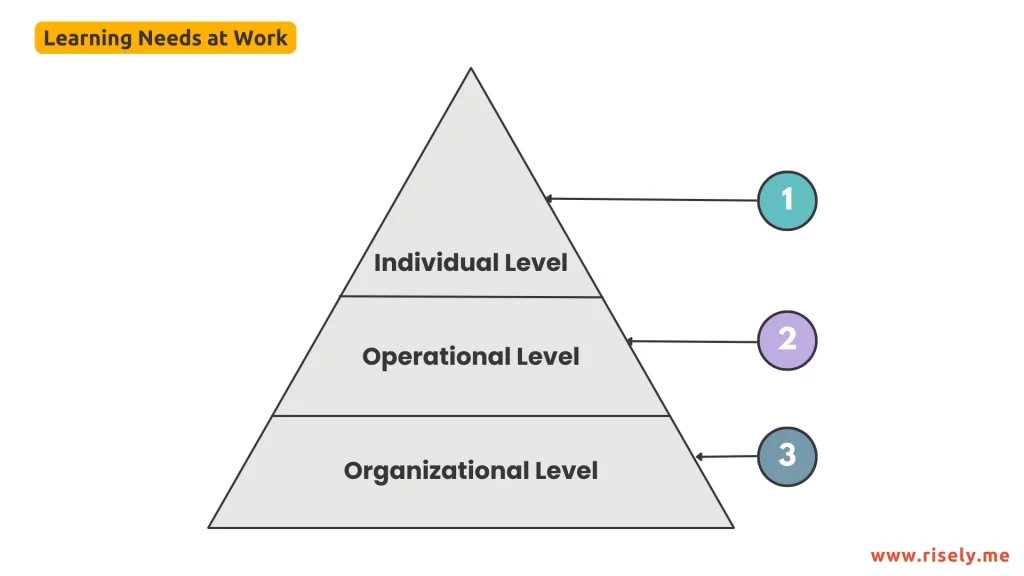
Organizational learning needs affect the whole company. Think: digital transformation skills, new compliance requirements, or cultural changes after a merger. These require broad programs and top-down support. They’re the easiest to identify because leadership usually names them explicitly.
Operational learning needs live at the team level. They’re about the specific skills and knowledge required for daily work in a department. A customer success team that needs better technical product knowledge. A finance team that needs to adopt a new reporting tool. These surface through performance data and manager observations.
Individual learning needs are the hardest to spot and the most impactful to address. They’re about a specific person’s skill gaps relative to their role and aspirations. They require one-on-one conversation, assessment data, and a manager who knows how to coach.
Most corporate learning strategies spend disproportionate effort on organizational needs (because they’re visible and executive-sponsored) and not enough on individual needs (because they require personalized attention at scale). This is exactly the gap that coaching, both human and AI-powered, is designed to fill.
How do you actually find hidden learning needs?
No single method catches everything. A reliable approach combines several.
Skills gap analysis
A formal skill gap analysis compares what skills a role requires against what the person in that role currently demonstrates. It’s the most structured approach and produces clear, actionable data.
You can use tools like Risely’s free skills gap analysis template for individuals or Risely’s free skills matrix template for teams to structure this process.
The trap here is stopping at identification. Finding a gap without understanding why it exists leads to training that treats symptoms. If a manager scores low on “delegation,” the reason matters: Are they a perfectionist who doesn’t trust their team? Do they lack a framework for what to delegate? Did they never see effective delegation modeled? Each root cause points to a different intervention.
Manager observations
Direct managers often see learning needs that formal assessments miss. They notice when someone avoids certain tasks, struggles with specific interactions, or applies a workaround instead of the right approach.
The challenge is that managers often don’t frame these observations as learning needs. They think “Sarah avoids client calls” rather than “Sarah has an unaddressed skill gap in client communication.” Coaching managers to translate behavioral observations into development opportunities is one of the highest-value investments an L&D team can make.
Performance data patterns
Look beyond individual metrics for patterns that reveal systemic learning needs. If multiple people on the same team struggle with the same output quality, that’s a team-level learning need, not an individual performance problem. If every new hire in a department takes twice as long as expected to reach productivity, the onboarding program has gaps.
Quarterly performance reviews, project post-mortems, and customer feedback all contain learning need signals. The key is reading them as development data, not just performance data.
Employee input
Surveys, focus groups, and one-on-one interviews each capture different information.
Surveys give you breadth: broad patterns across many people. Use scaled questions (“How confident are you in…”) alongside open-ended ones (“What skill would help you most in your current role?”).
Focus groups give you depth on specific issues. Bring together people affected by a particular challenge and explore what’s behind it. You’ll hear about process gaps, tool limitations, and skill deficits that no survey question would surface.
Interviews give you individual nuance. They reveal career aspirations, learning preferences, and personal barriers that group settings can’t capture. They’re time-intensive but irreplaceable for understanding individual learning needs.
Connecting learning needs to your L&D strategy
Identifying needs is only useful if it changes what you do. Here’s how to connect the dots.
Prioritize by business impact. Not all learning needs are equally urgent. A skill gap that’s causing customer churn is more pressing than one that’s slowing internal processes. Map each identified need to a business outcome, then prioritize accordingly.
Match the intervention to the need. Organizational needs call for programs. Operational needs call for team-based training. Individual needs call for coaching and personalized learning plans. Using a company-wide workshop to address an individual skill gap wastes everyone’s time. Using individual coaching to address a company-wide capability shift is too slow.
Build feedback loops. After deploying a learning intervention, measure whether the need is actually being met. Are performance gaps closing? Are managers seeing behavior change? Is the business outcome improving? Without feedback, you’re guessing about effectiveness.
Make learning needs assessment ongoing, not annual. The organizations that respond fastest to learning needs don’t wait for annual reviews. They’ve built continuous signals into their management practices: regular one-on-ones that include development discussion, skill assessment tools that track progress over time, and AI coaching that surfaces gaps through ongoing interaction.
When learning needs stay hidden, the cost is real
Unaddressed learning needs don’t sit quietly. They manifest as performance problems, team conflicts, turnover, and missed opportunities. The manager who can’t give feedback creates a disengaged team. The team that can’t adapt to new tools falls behind competitors. The high-potential employee who doesn’t see a growth path leaves.
The compounding nature of this cost is what makes proactive identification so valuable. Catching a learning need early, before it becomes a performance problem, is dramatically cheaper and more effective than fixing the downstream damage.
This is one of the strongest arguments for continuous coaching in the workplace. Platforms like Risely don’t just assess skills periodically; they identify learning needs through ongoing coaching conversations. When a manager discusses a challenge with Merlin and the conversation reveals a pattern of avoiding conflict, that’s a learning need surfacing in real time, at the moment when the person is most open to addressing it.
The goal isn’t perfect identification of every learning need. That’s impossible. The goal is building systems, conversations, and tools that surface the most important needs early enough to address them before they become expensive problems. Start with the framework above, layer in assessment and coaching tools, and keep listening to the signals your organization is already sending.
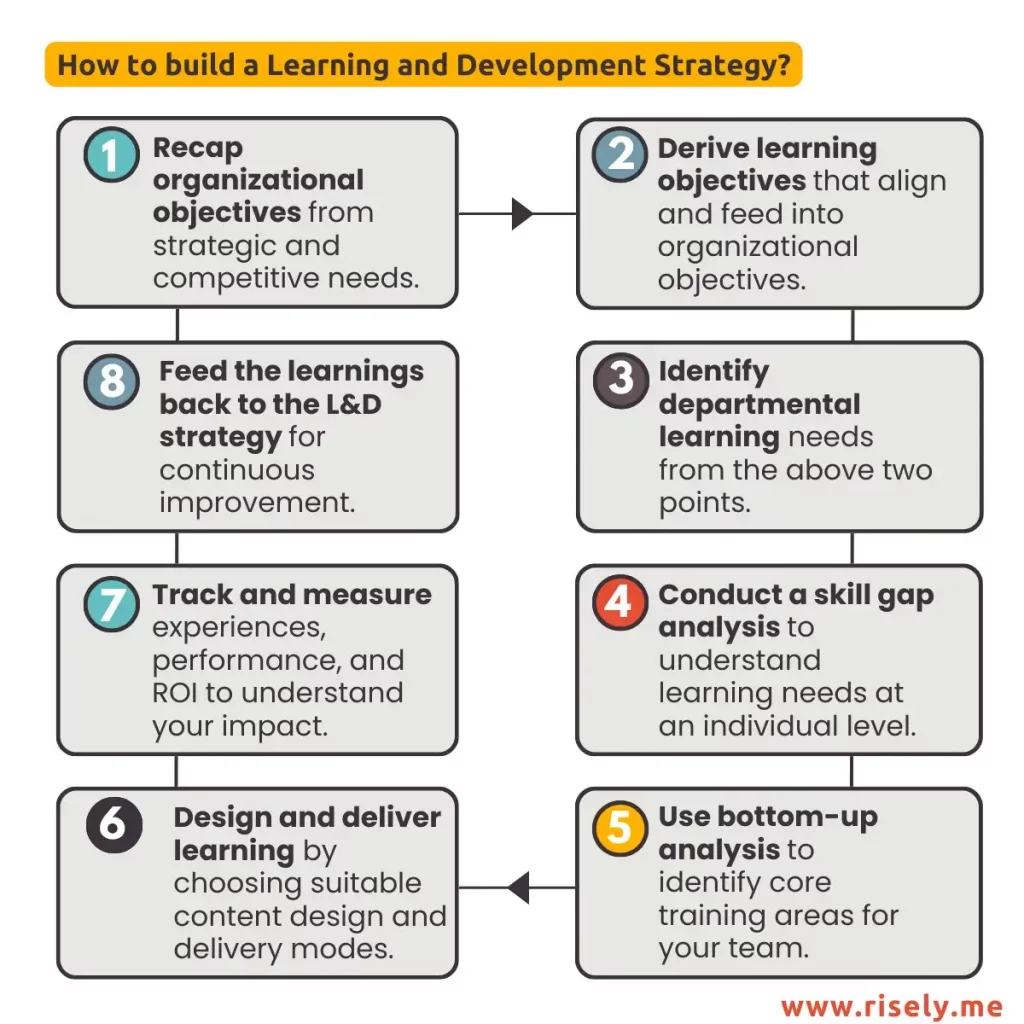
Read more: How To Build A Learning And Development Strategy?
Related reading: