
You spent $40,000 on a beautifully designed e-learning module. The graphics were polished, the voiceover was professional, and the quiz questions covered every topic. Six weeks later, nobody on the team has changed a single behavior.
The content was fine. The instructional design was fine. The problem was that nobody designed the learning itself: the practice, the feedback, the real-world application, the reinforcement. That’s the gap learning design fills, and it’s why the smartest L&D teams have moved past instructional design as their primary framework.
What is learning design, really?
Learning design is the systematic approach to creating experiences that help people develop, retain, and apply new skills. It includes content creation (that’s the instructional design part), but it also includes everything that happens around the content: how learners are motivated, where they practice, when they get feedback, and what support exists after the formal program ends.
The simplest way to think about it: instructional design asks “how do we teach this?” Learning design asks “how do people actually learn this, and what do we need to build around the content to make it stick?”
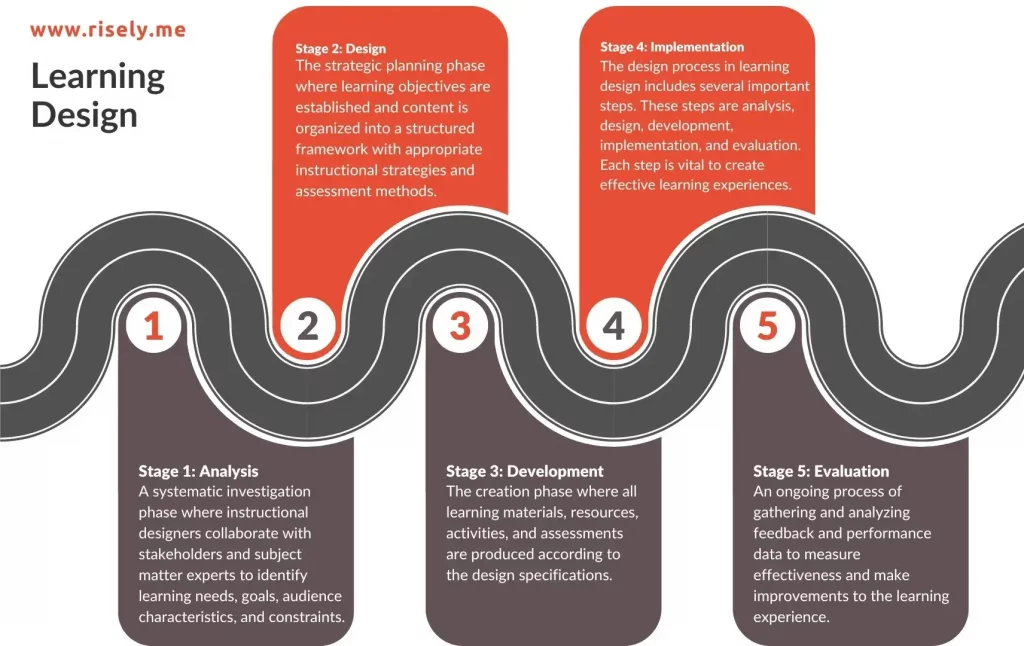
The design process follows five phases: analysis, design, development, implementation, and evaluation. If that sounds like ADDIE, it is. The difference isn’t the framework. It’s how deeply you engage with the learner’s reality at each phase.
How did we get from instructional design to learning design?
Instructional design emerged when corporate training meant a facilitator, a conference room, and a binder. The challenge was organizing content clearly and delivering it efficiently. That challenge has been solved.
The new challenge is different. Content is everywhere. Your people can find a YouTube video or a LinkedIn Learning course on almost any topic in 30 seconds. What they can’t find is a structured path that takes them from “I know what good feedback is” to “I consistently give good feedback even when it’s uncomfortable.” That transition from knowing to doing is what learning design is built for.
Three forces drove the shift:
- Technology expanded access but not quality. Having 15,000 courses available doesn’t mean anyone is learning. It often means everyone is overwhelmed.
- Neuroscience showed that passive consumption doesn’t stick. Reading about a skill and practicing a skill activate different parts of the brain. Learning design incorporates practice, not just content.
- The workplace changed. Employees can’t disappear for three days of classroom training. Learning needs to happen in the flow of work, in short bursts, with immediate application.
Why does learning design matter more than content quality?
This might sound counterintuitive, but mediocre content in a well-designed learning experience outperforms excellent content with no design around it. Every time.
Because content alone doesn’t change behavior. A 100-page guide on coaching skills might be comprehensive and accurate, but if there’s no structured practice, no feedback, and no reinforcement, the reader will forget 90% within a week. That’s not a guess. It’s what the forgetting curve predicts, and it’s what every L&D team observes when they track post-training behavior.
Here’s what good learning design gives you that content alone can’t:
Relevance from day one. Design starts with what the learner needs to do differently, not what the subject matter expert wants to teach. That alignment means every minute of the learning experience feels worth the learner’s time.
Built-in practice. For every concept, there’s an opportunity to try it. Not a quiz about it (quizzes test recall, not ability) but actual practice. Simulating a difficult conversation. Making a decision with incomplete information. Coaching a peer through a problem.
Feedback that changes behavior. Not a grade. Not a completion certificate. Specific, timely feedback on what you did well and what to adjust. This is where AI coaching tools like Merlin are changing the game for L&D teams, because they provide personalized feedback at the moment of practice, not days later in a review session.
Reinforcement after the program ends. The biggest gap in most training isn’t during the program. It’s the week after. Learning design plans for that gap with nudges, follow-up activities, peer check-ins, and coaching conversations that keep the skill developing long after the formal learning is done.
What are the 7 pillars of effective learning design?
1. Strategic alignment
Every learning experience should connect to a business outcome within two steps. “This module builds feedback skills” connects to “managers who give better feedback have lower team attrition” which connects to “reducing attrition saves us $X per quarter.”
If you can’t make that connection, question whether the learning experience belongs in your program at all.
2. Learner centricity
Design for the person doing the learning, not the person commissioning the training. That means understanding their current skill level, their daily work context, their preferred learning formats, and the specific situations where they’ll need to apply what they learn.
Build learner personas the same way product teams build user personas. A new manager promoted from an IC role has completely different needs than a seasoned leader joining from another company.
3. Engagement by design
Engagement isn’t about making learning “fun.” It’s about creating the right level of challenge. Too easy and people tune out. Too hard and they give up. The sweet spot is a challenge that stretches them just beyond their current ability with enough support to succeed.
Practical engagement tactics that work: scenario-based learning with branching decisions, time-pressured problem-solving, peer collaboration on real business challenges, and the ability to choose their own learning path within a structured framework.
4. Effective structure
Chunk content into focused modules of 15-20 minutes each. Sequence them from foundational to applied. Start each chunk with a clear “after this, you’ll be able to…” statement and end with a practice activity that proves it.
A well-structured learning program on, say, project management basics might look like this:
| Module | Focus | Duration | Practice Activity |
|---|---|---|---|
| 1 | What defines a project vs. ongoing work | 15 min | Classify 5 real examples from your team |
| 2 | Scoping: defining what’s in and out | 20 min | Write a scope statement for your current project |
| 3 | Timeline estimation (why we always get it wrong) | 20 min | Re-estimate a past project using the new framework |
| 4 | Stakeholder communication plans | 15 min | Draft a comms plan and get peer feedback |
Each module builds on the previous one. Each one includes practice that connects to real work.
5. Learning transfer
The gap between “I learned it in training” and “I do it at work” is where most L&D investment gets lost. Designing for transfer means building bridges across that gap.
Effective transfer tactics: follow-up assignments that require using the skill at work within 48 hours, coaching conversations to troubleshoot application challenges, peer accountability groups, and daily nudges that prompt practice. This is the approach Risely takes with its skill development platform, embedding reinforcement directly into the daily workflow.
6. Evaluation framework
Decide what “success” means before you build anything. Then design your assessments around that definition.
If success means “managers give feedback more frequently,” measure feedback frequency at 30, 60, and 90 days post-program. Don’t measure quiz scores or satisfaction ratings. Those tell you about the experience, not the outcome.
Two types of data to collect:
- Program data (completion rates, engagement metrics, assessment scores) tells you whether the design is working.
- Impact data (behavior change, team performance, business outcomes) tells you whether the learning is working.
7. Support systems
A well-designed learning experience can still fail if the environment doesn’t support it. Managers who discourage employees from taking time for development, senior leaders who don’t model the behaviors being taught, and cultures that punish mistakes all undermine learning transfer.
Design your support system intentionally. That might mean training managers on how to support their team’s development, creating safe spaces for practice (like AI coaching sessions where nobody else sees the conversation), or building peer networks that sustain momentum after the formal program ends.
Janis Cooper shared valuable insights on building effective learning experiences in a podcast with Risely:
Where should you start?
Pick your highest-priority skill gap. Audit what content you already have for it. Then design the experience around that content: the practice activities, the feedback mechanisms, the reinforcement plan, and the success metrics.
You don’t need to redesign everything at once. Start with one learning path. Apply these principles. Measure the result. If it works better than your current approach (it will), extend the model to your next priority.
The shift from instructional design to learning design isn’t about throwing out what you know. It’s about expanding what you do. Content creation is still important. But it’s the 30% of the job. The other 70%, designing the experience that turns content into capability, is where your impact as an L&D professional actually lives.