

As we discussed in one of our earlier blogs, bias exists in everyone in some form or the other due to constant conditioning over the years. Consequently, bias unintentionally affects our decisions without even us recognizing the same, even when trying to be our best rational selves. Gender bias in the workplace can have a detrimental impact on our decision-making and interactions too. This is even more pertinent for those in leadership or managerial roles. Therefore, it is imperative to take extra care to weed out bias from our minds before embarking upon your next venture. You can read more about the most common forms of biases seen in the workplace here.
As a manager, ensuring that everyone in the workplace is treated equally and fairly is one of your main tasks. Unfortunately, this isn’t always easy, especially when gender bias exists. Gender bias in workplace can take many forms, from straightforward chauvinism to subtle discrimination. As a manager, it’s essential to understand the effects of gender bias in the workplace on work performance and how to tackle it head-on. Because otherwise, it will create a blind spot for you. In this blog, we’ll explain what gender bias is, how it can impair a manager’s work, and some tips on overcoming it. So, whether you’re a new manager or experienced, read on to learn more!
What is Gender Bias?
So, let’s talk about gender bias in the workplace. It’s a real issue that affects many of us, whether we realize it or not. Gender bias, also known as sexism, happens when people are treated differently because of their gender identity or expression. And guess what? It’s not just about women facing workplace discrimination. People of all genders can experience bias based on stereotypes and prejudices.
Think about it: have you ever noticed specific individuals getting preferential treatment simply because they’re male? Or have you witnessed someone being overlooked for a promotion because of their gender identity? These are just a couple of examples of how gender bias can rear its ugly head in the workplace.
Now, let’s talk about the impact of gender bias on work performance. Research shows women are less likely to climb the career ladder than men. Why? It often comes down to doubts about their abilities, a lack of trust, and even lower confidence in their leadership skills. Imagine constantly feeling like you have to prove yourself just because of your gender. It’s exhausting, right?
And it’s not just about promotions. Gender bias can also affect team morale and productivity. When people feel like they’re being mistreated, they find it hard to stay motivated and engaged. And let’s not forget about burnout. Research suggests that female managers experience burnout more frequently, likely due to the added pressure of dealing with biased attitudes in the workplace.
So, what can we do about it? Well, for starters, we can all consciously challenge gender bias when we see it. Whether we speak up against discriminatory behavior or actively support our colleagues, every little bit helps.
Types of Gender Bias and Its Impact in the Workplace
Let’s talk about the different types of gender bias that exist in the workplace. It can manifest in various ways few common types:
- Stereotyping: Have you heard someone say, “Women are too emotional to be leaders” or “Men are better suited for technical roles”? That’s stereotyping in action. Stereotypes are oversimplified beliefs about certain genders that can influence how people are perceived and treated in the workplace.
- Tokenism: Have you ever been the only woman or non-binary person in a meeting or on a team? That’s tokenism—the practice of including a small number of people from underrepresented groups to give the appearance of diversity. While it may seem like progress, tokenism often makes these individuals feel isolated or overlooked.
- Microaggressions: Microaggressions are subtle, often unintentional comments or actions that reinforce stereotypes or prejudices. For example, asking a female coworker if she takes notes in a meeting or assuming that a non-binary colleague prefers to be referred to as “he” or “she” can be microaggressions.
Now, let’s talk about the impact of gender bias on individuals and organizations. When people experience gender bias in the workplace, it can have far-reaching consequences.
For individuals, gender bias can erode self-confidence and self-worth. Imagine constantly being told that you’re not as capable as your male counterparts or that your opinions aren’t as valuable because of your gender. It’s demoralizing. Gender bias can also limit career advancement opportunities, as individuals may be passed over for promotions or not given the same opportunities for growth and development as their peers.
However, gender bias’s impact doesn’t stop at the individual level; it can also have ripple effects throughout an organization. When talented individuals are sidelined or undervalued because of gender, morale, productivity, and innovation can decrease. Additionally, organizations that fail to address gender bias in the workplace risk damaging their reputations and losing top talent to more inclusive competitors.
What does Gender Bias in Workplace look like?
Bias is dangerous because it works subtly. This is simply social conditioning to achieve the desired results without any policy intervention. Sometimes, the person doing it and the victim might not even realize it. Over time, it becomes a tendency and gets normalized all around. However, keeping a keen eye on and recognizing instances where bias is a motivator is crucial.
Examples of gender bias in the workplace
Gender bias is present in the corporate environment in multiple places. When considering suitable candidates for top positions, people usually overlook women. Similarly, gender bias also manifests as:
- Performance perception bias: People assume that the men did most of the work in a team project. The women, at best, added something to improve the presentation. This is gender bias at play that depicts women as unfit for assertive, analytical, and critical tasks.
- Biased job designs: Only men are considered when some roles are designed. This is evident from the language employed in job descriptions and advertisements, which also use words targeting a specific gender. This effectively gatekeeps them from the other genders.
- Discriminatory hiring practices: Several interviewers adopt discriminatory hiring practices. They might create the persona of the ideal candidate of a specific gender. Moreover, it is a trend that interviewers ask women more questions about their communication and soft skills than analytical and mathematics. Further, many people avoid hiring women to avoid providing paid maternal leaves and other perks
- The gender pay gap: An issue that persists even after considerable highlighting. Several industries pay men and women differently for the same work. Although the legal position guarantees equality, the ground reality remains grim till date.
- The glass ceiling: Unfortunately, top-level positions have become the male gender’s property. Women and other marginalized communities have a hard time breaking the glass ceiling into the top brass. This happens as they are perceived as unfit and insufficient. Additionally, women tend to lack mentors and access to opportunities too.
- Harassment: Women and gender minorities are more likely to face sexual and mental harassment in the workplace, as it is presumed that the rest will not trust their words. Their success is degraded by presenting it as a result of sexual favors rather than merit and ability.
How can Gender Bias hamper a Manager’s Work?
It becomes crucial for a manager to tackle gender bias because of the problems it can present for you. First and foremost, diverse teams are often more productive than homogenous ones. The scope for creativity and innovation is manifold higher. Resultantly, a diverse team promises better performance and productivity. However, creating a diverse team is contingent upon the absence of gender bias. Moreover, gender bias can harm the external perception of the team and the people, which is unsuitable for the manager. A manager or a leader needs to get of gender bias if they wish to succeed.
As a manager, it can be challenging to combat gender bias. It manifests itself differently, but all share one common goal - to advance their colleague’s careers. Unfortunately, this goal becomes difficult when everyday interactions unconsciously apply and reinforce gender bias. To overcome gender bias, managers need to understand how it affects them and make positive changes that will benefit the entire team. This can be difficult, but by taking the time to understand the problem and put in the effort, managers can create a more inclusive and equitable workplace for all employees. There are many steps managers can take to achieve this, but the most important thing is to start somewhere.
Understanding and Addressing Gender Bias
It’s not always easy to spot bias, especially when it’s subtle or ingrained in our everyday behaviors. However, by reflecting on our attitudes and behaviors, managers can start to identify and address bias in themselves and their teams.
1. Self-Reflection and Awareness
First things first—you’ve got to start with yourself. Take a moment to reflect on your beliefs, attitudes, and behaviors regarding gender. Ask yourself questions like:
- Do I have any preconceived notions about what men or women are capable of?
- Have I ever made assumptions about someone’s abilities based on their gender?
- Do I treat people differently based on their gender without realizing it?
- By examining your own biases and becoming more aware of how they might influence your actions, you can begin to challenge and change them.
Let me give you an example. Imagine you’re in a meeting, and a female colleague suggests an idea that you initially dismiss. Upon reflection, you may have overlooked her contribution because of unconscious biases about women’s abilities in certain areas. By acknowledging and addressing this bias, you can work towards creating a more inclusive and equitable work environment.
2. Identifying Biased Behaviors and Practices
Once you’ve become more aware of your biases, it’s time to turn your attention to the behaviors and practices within your team or organization. Pay close attention to things like:
- Who gets assigned to leadership roles or high-profile projects?
- Whose ideas are given more weight in meetings or discussions?
- Are there any patterns of exclusion or marginalization based on gender?
- By actively observing these behaviors and practices, you can identify areas where bias may be present and take steps to address them.
For instance, let’s say you notice that male team members consistently receive more opportunities for leadership roles or promotions than their female counterparts. This could signify gender bias in your organization’s promotion or leadership selection processes. Highlighting these disparities and advocating for more equitable practices can help create a more level playing field for everyone.
In conclusion, recognizing gender bias as a manager is the first step toward creating a more inclusive and equitable workplace. By engaging in self-reflection, raising awareness, and actively challenging biased behaviors and practices, you can help foster a culture where everyone feels valued and respected, regardless of gender.
Ways to tackle Gender Bias in the Workplace
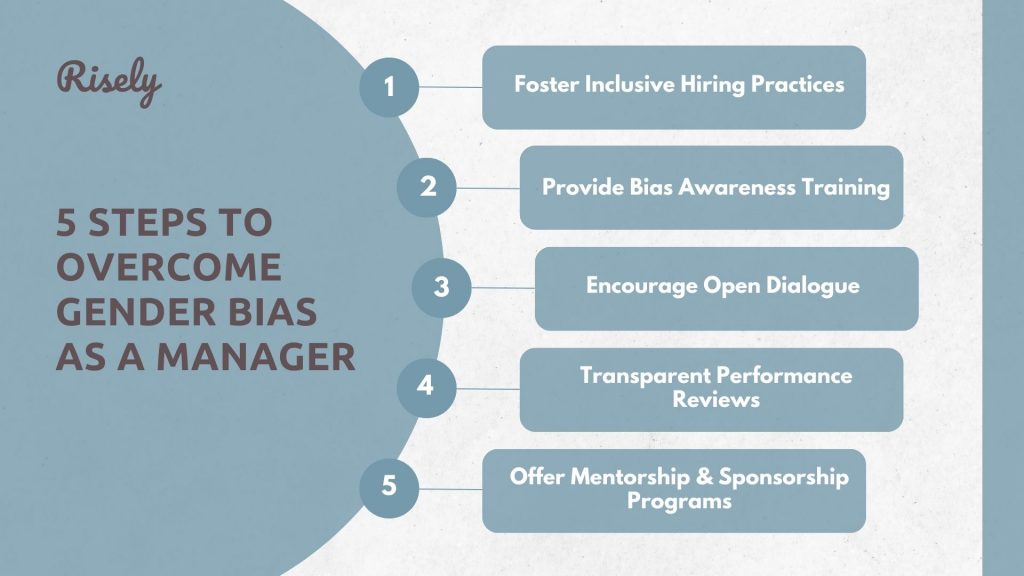
Gender bias in the workplace can be a tricky issue to tackle, but it’s essential to start somewhere. Here are five ways to tackle gender bias in the workplace:
Encourage a Policy of Transparency
Begin the process of tackling gender bias by acknowledging the presence of the issue. Additionally, you can provide data to understand it better. The next step would be to collect employee opinions to understand their lived experiences as persons of gender that are biased against. This will throw light on numerous issues ranging from interactions in the social space to disadvantages observed in the administration of pay and perks. This informal understanding of issues can pave the way for a formal investigation upon which amendments can be based.
Re-haul your Recruitment Process
Similar to your organization, you can test your hiring process to see if it suffers from gender bias and to what extent. In this, you can ensure that you use gender-neutral language and themes and that your questions are not based on experiences central to any particular gender. Encouraging blind applications can be a great tool to increase the number of women. Lastly, go into the interview process with an open mind, absent of preconceived notions of ability specific to any gender.
Build the much needed interviewer skills to get started: 5 Interviewer Skills That Every Manager Needs For Smart Hiring
Start the Conversation
Taking the first few steps won’t be the end of it; eradication of gender bias will take a long time. Therefore, it is vital to keep the conversation going on. Ensure all employees feel comfortable reporting any gender bias they experience. This will help you to identify and address any problematic behavior quickly and appropriately. This can help to create a more open and understanding environment and ultimately help to reduce gender bias in the workplace.
Redesign your Rewards Program
If you see differences in the rewards given to people along the lines of gender, your program needs a redesign. Reward employees for working hard without privileging one group over another. You should enable an environment where every employee can equally access opportunities for personal and professional development.
Offer Anti-Gender Bias Training
We have understood that bias occurs due to social conditioning over time. Therefore, undoing it might not be the fastest process. A manager can then offer training against underlying biases to employees. This can be in the form of awareness programs, employee resource groups, and sensitivity and diversity training that educates them about the various manifestations of gender bias and its impact. This exercise empowers employees and allows them to challenge bias head-on. Pairing this with programs that address gender-specific development helps women build the skills to navigate those challenges directly.
Conclusion
In summary, gender bias in the workplace is a problem that needs to be tackled vigilantly. As a manager, it’s essential to be aware of gender bias and how it can affect your work. By understanding the definition of gender bias and how it can hinder your work, you can start to tackle it head-on. There are various ways you can help reduce gender bias in the workplace, and this blog has underlined a few of them. Continue reading here for more informative content on management and leadership!