


Global spending on workplace training reached almost $401 billion in 2024(1). Ask the people it is spent on and the picture thins out fast: in PwC’s Global Workforce Hopes and Fears Survey 2025, only 51% of non-managers said they have the resources they need for learning and development, against 72% of senior executives(2).
Most L&D teams know exactly why. Producing content for thousands of learners, in several languages, against a skills list that keeps moving, is more work than the team has hours for. That gap is what is pushing L&D leaders toward generative AI.
Adoption is no longer the open question. McKinsey’s State of AI: Global Survey 2026(3) puts the share of organizations using generative AI at 72%, up from 33% in 2024. What is still open is what a learning and development function should do with it.
In practice the useful applications cluster in a few places: drafting and adapting content, delivering coaching at a scale a small team cannot staff, and reading the data on what learners actually do.
This guide covers:
- What generative AI changes about the way an L&D team works
- What four organizations have built with it
- A five-step way to start without a new budget line
- Where it goes wrong, and what to check before anything reaches a learner
Understanding Generative AI for Learning and Development
Generative AI in an L&D context means a model that produces new material on request: a draft module, a set of assessment questions, a translated version of an existing course, a coaching reply to something a learner just typed. That last one is what separates it from the automation L&D teams already had. A learning management system routes people to content that already exists. A generative system writes the next thing in response to what the person said.
The practical difference shows up when a learner is stuck. An LMS serves the same module again. A generative system can restate the idea a different way, ask which part is unclear, or work through the learner’s own example instead of the one in the deck.
Here is what that looks like in a live coaching conversation:
None of this removes people from L&D. It removes a category of work: first drafts, reformatting, translation, and the follow-up question asked at 11pm when nobody on the team is online.
Read further: 7 Easy Ways to Use AI in Learning and Development
Pros & Cons of Generative AI for Learning and Development
The gains and the risks are both real, and they land on different parts of the function. Here is the trade in full before we get to what teams have actually built.
| Advantages of Using GenAI for L&D | Risks in Using GenAI for L&D |
|---|---|
| ✅ Adaptive Learning Paths: Creates personalized learning journeys based on individual progress, style, and pace - no more one-size-fits-all training | ❌ Human Connection Gap: GenAI misses nuanced emotional cues and complex interpersonal dynamics that human facilitators naturally grasp |
| ✅ Time-Saving Content Creation: Generates first drafts of training materials, quizzes, and assessments in minutes rather than hours | ❌ Data Privacy Concerns: Raises questions about information security and confidentiality of learning data |
| ✅ 24/7 Learning Support: Offers round-the-clock assistance for learners across different time zones and schedules | ❌ Quality Consistency: Can produce uneven or generic content that needs significant human refinement |
| ✅ Consistent Feedback: Provides immediate, standardized feedback while maintaining objectivity across all learners | ❌ Integration Challenges: May not seamlessly fit with existing learning management systems or company processes |
| ✅ Data-Driven Insights: Tracks learning patterns and identifies skill gaps with precision that manual monitoring can’t match | ❌ Over-Reliance Risk: Could lead to decreased human involvement in critical developmental conversations |
The column on the right decides whether the column on the left survives contact with a real programme. Quality consistency is the one that catches teams out: a model will produce a fluent, plausible module on a topic it has no reliable information about, and nothing in the output tells you it has done so.
How are L&D Teams Using Gen AI for Their Work?
Four organizations, and what each of them built.
Johnson & Johnson’s AI-powered Employee Assessments
Johnson & Johnson needed an efficient way to assess employee skills and align them with evolving business needs.
- Implemented AI-driven skills inference technology to evaluate employees’ competencies.
- Enabled personalized career development by identifying skill gaps and recommending targeted training.
This led to:
- More accurate skills assessment for leadership development.
- Improved training effectiveness, leading to enhanced workforce capabilities.
DHL – AI-Driven Career Marketplace
DHL wanted to improve employee retention and career progression by offering tailored development opportunities.
- Developed an AI-powered internal career marketplace to match employees with relevant positions.
- Recommended upskilling programs based on individual strengths and career aspirations.
The result?
- Boosted employee engagement and retention by providing clear career pathways.
- Created a more agile and skilled workforce through AI-guided training.
Best Friends Animal Society – AI-Powered Leadership Coaching
Best Friends Animal Society needed scalable leadership development for managers across different locations.
- Used Risely’s AI-powered leadership coaching for personalized feedback and growth plans.
- Integrated experiential learning, including equine-assisted leadership training, for a hands-on development approach.
The impact?
- Strengthened leadership culture within the organization.
- Increased engagement in leadership development initiatives.
Virti – Immersive AI-Driven Training
Organizations needed realistic, risk-free training environments to prepare employees for high-stakes scenarios.
- Built an immersive AI-powered platform using VR/AR for hands-on leadership training.
- Simulated real-world decision-making scenarios to improve leadership skills.
The result:
- Improved knowledge retention and decision-making abilities among trainees.
- Scaled immersive leadership training cost-effectively across organizations.
Getting Started with Generative AI for Learning and Development
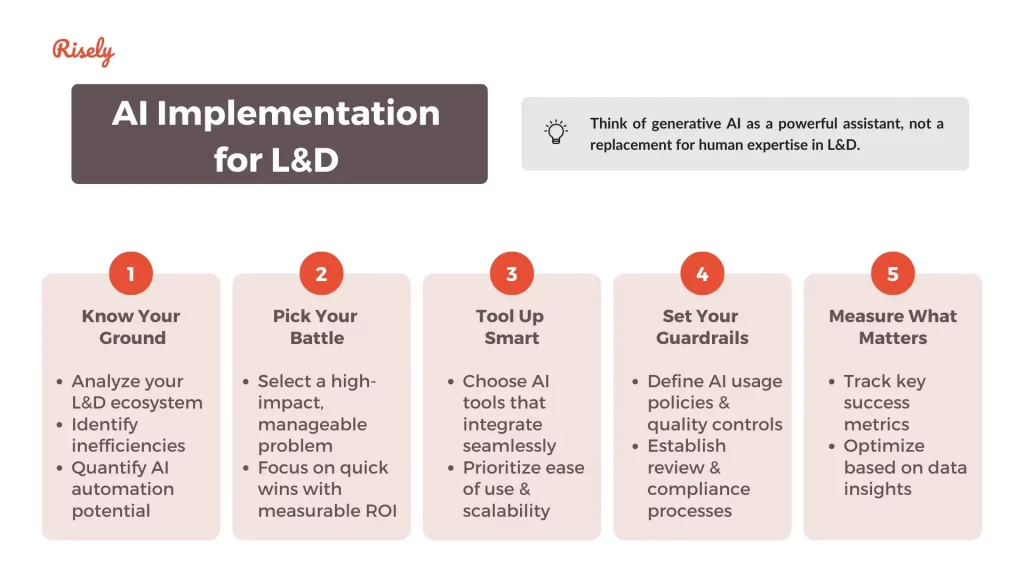
Five steps, none of which need a budget line you do not already have.
Step 1: Know Your Ground
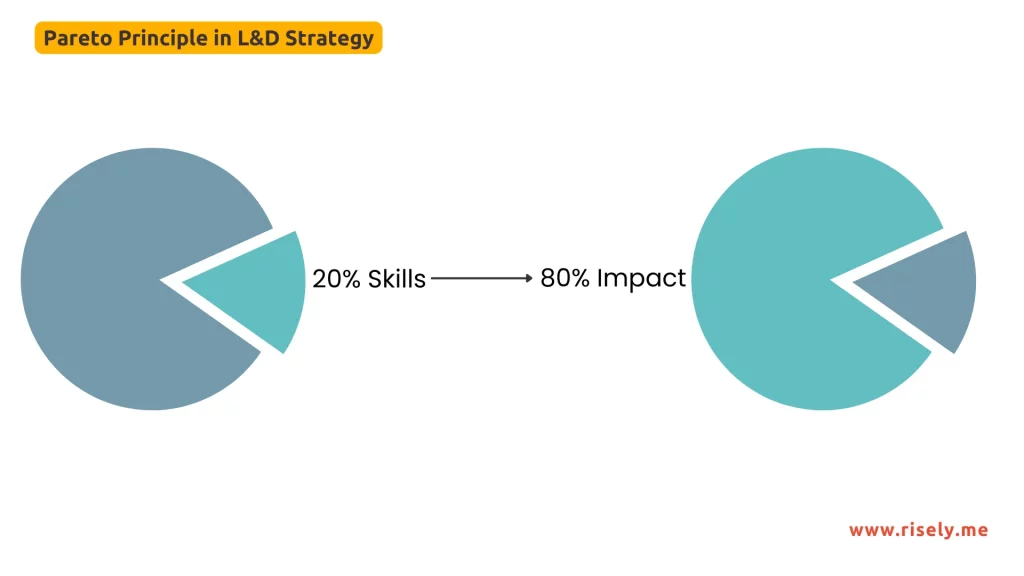
Map where the hours actually go before you buy anything. On most teams a large share sits in production: drafting, reformatting, translating, and writing assessments. That is the work generative AI is good at, and it is also the work nobody puts on a slide when the team asks for headcount.
Time three things specifically: how long one module takes from brief to release, how long a translated version takes on top of that, and how long assessment writing takes. Those numbers become the baseline you measure against later.
Step 2: Pick Your Battle
Pick one area under real pressure rather than reworking everything at once. If leadership and manager development is your patch:
- Are you spending weeks adapting content for different regions? Then your effort needs to focus on ensuring that localization is easier with generative AI for learning and development. For example, teams with leaders spread across different geographies use Risely’s AI coach Merlin to coach them in their own language, across 40 languages.
- Is your team drowning in assessment creation? Then something like Risely’s in-built leadership skills assessments will help you.
Pick something concrete enough to measure and large enough that your stakeholders care about the result. If leadership programmes are your whole remit rather than one slice of it, the programme-level view is set out separately in how AI is changing leadership development.
Step 3: Tool Up Smart
Buy for the workflow you picked, not for the demo. The tool has to work with the systems you already run, and your team has to be productive in it without training that costs more than the tool. Expect a few weeks before anything shows up in your numbers. Use free tiers, trials and pilots until you are sure.
Ask yourself:
- Will this tool actually solve your specific problems?
- Can your team learn it quickly?
- What’s the real cost when you factor in training and maintenance?
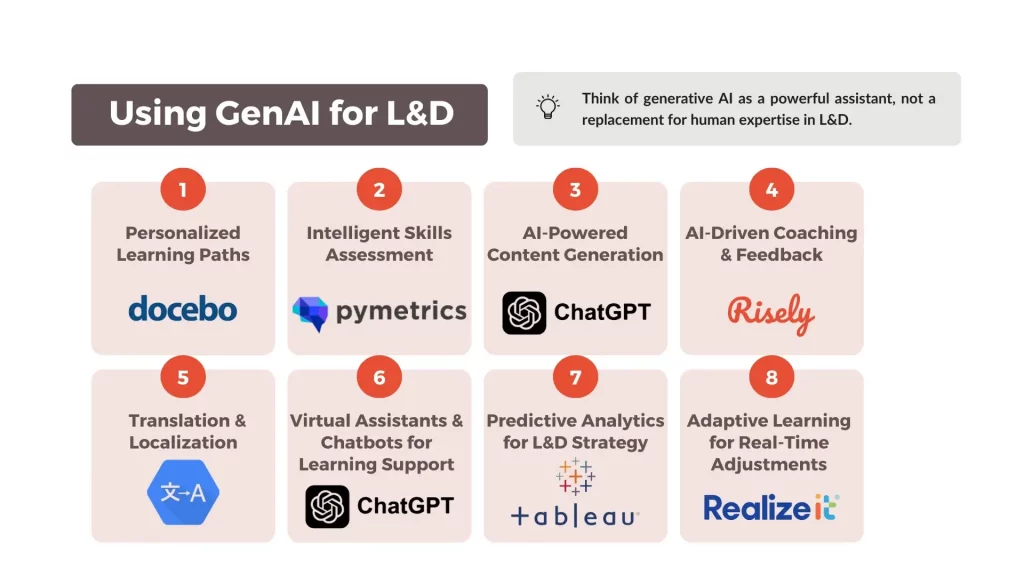
Feature lists are not the decision. Here is a short list of L&D tools that are straightforward to start with:
Step 4: Set Your Guardrails
Write the rules before the first draft, not after the first bad one. Name who reviews AI-generated content and signs it off. State what data can and cannot be pasted into a tool, including anything from performance reviews, exit interviews or employee records. Set the quality bar in writing. Keep it short enough that anyone on the team can follow it without asking.
Step 5: Measure What Matters
Pick three numbers and hold to them. Hours to produce a module. Days from request to release. Completion rate on the programmes you shipped this quarter. Learner satisfaction is worth collecting, but it moves for reasons that have nothing to do with the tooling, so do not let it stand in for the other three.
Record the baseline before you start, not afterwards. Without it you will not be able to tell a real saving from a quieter quarter.
Key Takeaways
- The first useful job for generative AI in L&D is production: first drafts, reformatting, translation, and assessment questions. That is where most teams find hours, and it is the work that is easiest to time.
- Everything that reaches a learner needs a named human reviewer with a checklist. Models write fluent material on topics they have no reliable source for, and the output gives no sign of it.
- Start with one workflow you already measure and already dislike. Localization and assessment writing are the two most common entry points, and AI-powered coaching is a common second step once the review process exists.
- Set the data rules on day one: what can be pasted into a tool, who reviews what, and what happens to anything a learner types into a coaching tool.