

Have you ever wondered why some colleagues thrive on detailed planning while others excel in spontaneous problem-solving? Or why certain team members make decisions based on pure logic while others weigh the human impact first? The Myers-Briggs Type Indicator (MBTI Test) offers a framework for understanding these fundamental personality differences. This comprehensive guide explores what MBTI is, breaks down all 16 personality types, examines the science behind the assessment, and shows HR professionals, managers, and individuals how to leverage personality insights for better teamwork, communication, and development.
What is MBTI? Understanding the Myers-Briggs Type Indicator
The Myers-Briggs Type Indicator (MBTI) is a personality assessment tool designed to identify how people perceive the world and make decisions. Developed by Katharine Cook Briggs and her daughter Isabel Briggs Myers in the 1940s, the framework was inspired by Swiss psychiatrist Carl Jung’s theory of psychological types.
Briggs and Myers created the MBTI with a specific mission: to make Jung’s complex theories accessible and practical for everyday use. During World War II, they believed that understanding personality differences could help people find work that suited them and improve workplace dynamics, which is a vision that remains relevant today.
The assessment doesn’t measure skills, intelligence, or emotional health. Instead, it identifies natural preferences, like the ways you instinctively gain energy, process information, make decisions, and organize your life. Think of it like being left-handed or right-handed: you can use both hands, but one feels more natural and requires less effort.
Today, MBTI is one of the most widely used personality assessments globally, with millions of people taking it annually. Organizations use it for:
- Team development: Understanding how different personalities work together
- Leadership coaching: Helping managers adapt their style to different team members
- Communication improvement: Bridging gaps between different thinking styles
- Career guidance: Identifying roles that align with natural preferences
- Conflict resolution: Understanding the root of personality-based tensions
- Organizational culture: Mapping the collective personality of teams and departments
How the MBTI Framework Works: The Four Dichotomies
MBTI organizes personality into four pairs of opposite preferences, called dichotomies. Your preference on each of these four scales combines to create your four-letter type code (like ENFJ or ISTP). Understanding these building blocks is essential to grasping how the 16 types emerge.
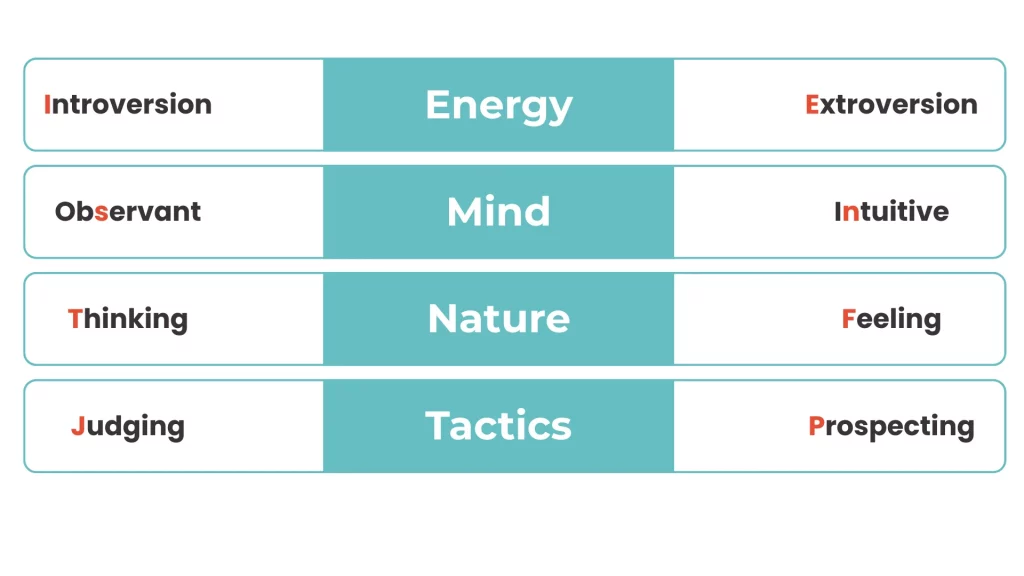
Extraversion (E) vs. Introversion (I): Where You Direct Energy
This dichotomy addresses where you get your energy and where you prefer to focus your attention.
| Extraversion (E) | Introversion (I) |
| Energized by interaction with people and the external world Thinks out loud and processes through discussion Prefers breadth of experience over depth Acts first, then reflects | Energized by solitude and internal reflection Thinks internally before speaking Prefers depth of experience over breadth Reflects first, then acts |
| Workplace behavior: Thrives in collaborative environments, enjoys meetings and brainstorming sessions, may dominate conversations | Workplace behavior: Prefers written communication or one-on-one meetings, needs quiet time to recharge, may be seen as reserved but is often deeply thoughtful |
Sensing (S) vs. Intuition (N): How You Gather Information
This dichotomy describes what you naturally pay attention to and trust when taking in information.
| Sensing (S) | Intuition (N) |
| Focuses on concrete facts and details from the five senses Lives in the present moment Trusts proven methods and practical experience Prefers step-by-step instructions | Focuses on patterns, possibilities, and the big picture Orients toward the future Trusts hunches and theoretical understanding Prefers understanding concepts over memorizing steps |
| Workplace behavior: Detail-oriented, values accuracy, asks “What are the facts?” appreciates clear, tangible data | Workplace behavior: Innovative, future-focused, asks “What could this mean?” comfortable with ambiguity and abstract ideas |
Thinking (T) vs. Feeling (F): How You Make Decisions
This dichotomy reveals what you prioritize when coming to conclusions or making choices.
| Thinking (T) | Feeling (F) |
| Makes decisions based on logic and objective analysis Values fairness, consistency, and truth Steps back from situations to assess objectively Asks “What makes sense?” | Makes decisions based on values and impact on people Values harmony, empathy, and authenticity Steps into situations to understand personal impact Asks “What matters to people?” |
| Workplace behavior: Direct and candid, focuses on task over relationship, values competence, comfortable with impersonal critique | Workplace behavior: Relationship-oriented, considers team morale, values appreciation, prefers diplomatic communication |
Judging (J) vs. Perceiving (P): How You Approach the Outside World
This dichotomy describes your preferred lifestyle and how you deal with structure and flexibility.
| Judging (J) | Perceiving (P) |
| Prefers structure, plans, and organization Likes decisions to be made and settled Works steadily toward deadlines Enjoys completing tasks and checking them off | Prefers flexibility, spontaneity, and keeping options open Comfortable with ambiguity and open-ended situations Often works in bursts, especially near deadlines Enjoys starting new projects |
| Workplace behavior: Creates schedules, meets deadlines early, prefers clear expectations, can be stressed by last-minute changes | Workplace behavior: Adaptable, handles unexpected changes well, multi-tasks naturally, may struggle with rigid timelines |
How do These Combinations Create 16 Types of Personalities?
Your four-letter type code represents your preference on each dichotomy. For example, ENFJ means:
- E (Extraversion): Energized by people and external interaction
- N (Intuition): Focuses on possibilities and big-picture thinking
- F (Feeling): Makes decisions based on values and people impact
- J (Judging): Prefers structure and organization
These preferences interact and influence each other. An ENFJ’s preference for Feeling is expressed differently than an ISFJ’s Feeling preference because they process information differently (Intuition vs. Sensing). This interaction creates 16 distinct personality patterns, each with its own strengths, challenges, communication style, and workplace contributions.
Understanding these four dichotomies gives you the foundation to appreciate why your INTJ colleague wants all the data before deciding while your ESFP teammate is ready to jump in and figure it out as they go. Neither approach is wrong. They’re simply different ways of engaging with the world.
Taking the MBTI Personality Test: What You Need to Know
Understanding your MBTI type starts with taking an assessment, but not all personality tests are created equal. The way you’re assessed can significantly impact the accuracy of your results.
Traditional MBTI vs. Modern Approaches
The official MBTI assessment consists of a series of multiple-choice questions where you select between two options that represent opposite preferences. You might see questions like:
- “At a party, do you: (A) interact with many people, or (B) interact with a few people you know well?”
- “Do you prefer to: (A) work to deadlines, or (B) work without fixed deadlines?”
While this format has been used for decades, it comes with significant limitations.
- Easy to Game When you can see exactly what each question is measuring, it’s simple to answer based on who you want to be rather than who you are. Someone applying for a leadership role might unconsciously lean toward “Extraversion” and “Judging” answers even if they’re naturally introverted and spontaneous.
- Social Desirability Bias People tend to choose answers that sound more socially acceptable or professionally desirable. In workplace contexts, certain traits may seem more valued, leading test-takers to present an idealized version of themselves.
- Context Blindness Static questions don’t account for context. You might be extraverted with close friends but introverted in professional settings. MCQ tests force you to choose one answer without considering these nuances.
- Question Fatigue Traditional assessments can include 90+ similar-sounding questions, leading to reduced attention and less thoughtful responses as you progress through the test.
- Binary Thinking Multiple-choice formats reinforce the misconception that MBTI puts you in rigid boxes, when in reality, most people exist on a spectrum for each preference.
Introducing Risely’s AI-Led MBTI Assessment
Risely has reimagined personality assessment using conversational AI that addresses these traditional limitations.
How is it Different?
Conversational Rather Than Transactional Instead of answering 90 isolated questions, you engage in a natural dialogue with an AI coach. The conversation flows organically, asking follow-up questions based on your previous answers. This approach feels less like taking a test and more like talking with a thoughtful colleague who wants to understand you.
Contextual and Adaptive The AI doesn’t just ask “Are you organized?” Instead, it might ask about a specific recent project, how you approached it, what challenges you faced, and how you responded. By gathering information about actual behaviors in real contexts, it builds a more accurate picture of your natural preferences.
Less Gameable Because the questions adapt dynamically to your responses and probe for specific examples, it’s much harder to present a false image. The AI identifies patterns across your entire conversation rather than tallying up individual question responses.
Reduces Response Bias Conversational assessments feel less formal and evaluative, which helps people respond more authentically. You’re less likely to overthink your answers when you’re simply describing your actual experiences.
More Engaging By varying question formats and following interesting threads in your responses, the AI maintains your attention and engagement throughout the assessment. This leads to more thoughtful, accurate answers.
Tips for Getting Accurate Results with MBTI Assessments
Regardless of which assessment you take, these strategies help ensure your results truly reflect your personality:
- Consider Your Natural State Answer based on what feels most natural and effortless to you, not what you’ve learned to do or what you think you should do. If you’re naturally introverted but have developed strong presentation skills for work, you’re still likely an introvert. Understanding how introverted leaders lead effectively can help you reframe introversion as a leadership asset rather than a liability.
- Think About Your “Default Settings” Imagine you’ve had a long week and you’re tired. How would you naturally prefer to spend your time? The preferences that emerge when you’re drained often reveal your true type more than how you act when you’re “on.”
- Focus on the Workplace Context If you’re taking the assessment for professional development, think specifically about your behavior and preferences at work. Your “home self” and “work self” might differ, but for workplace applications, professional context is most relevant.
- Don’t Overthink Your first instinct is often the most accurate. If you find yourself going back and changing answers or agonizing over questions, you’re probably overthinking it.
- Be Honest About Weaknesses The assessment is only describing you. Admitting that you struggle with long-term planning or that you avoid conflict doesn’t make you flawed; it makes you self-aware.
What Happens After You Complete the Test
Once you receive your four-letter type code, the real work begins. Your type is a starting point for exploration, not a final destination. With Risely’s AI assessment, you also receive ongoing AI coaching that’s personalized to your type. Rather than just reading a static report, you can ask questions like “As an INFP, how should I approach giving critical feedback?” or “What’s the best way for me to manage this ESTJ team member?” The AI provides real-time, type-aware guidance that evolves with your needs.
Taking the MBTI assessment is the first step toward better self-understanding and more effective collaboration. By choosing an assessment method that prioritizes accuracy and context, like Risely’s conversational AI approach, you ensure that the insights you gain truly reflect who you are and how you can develop.
The 16 MBTI Personality Types: Complete Descriptions
The 16 MBTI personality types emerge from combinations of the four dichotomies, creating distinct patterns of thinking, working, and interacting. These types are often grouped into four temperament categories: Analysts, Diplomats, Sentinels, and Explorers—which share certain core characteristics. Understanding each type helps you recognize diverse strengths on your team, adapt your communication to different colleagues, and appreciate the unique contributions each personality brings to the workplace.
Analysts: Strategic and Rational Thinkers
Analysts combine Intuition (N) with Thinking (T), creating personalities that are strategic, independent, and driven by logic and competence. They excel at seeing patterns, solving complex problems, and driving innovation.
INTJ - The Architect
Strategic, independent, analytical, and visionary. INTJs are the long-term planners of the personality world, always thinking several steps ahead. The “cold, emotionless mastermind” trope doesn’t capture real INTJs. While they process emotions privately and prioritize logic in decision-making, INTJs have rich inner emotional lives. They’re not trying to be insensitive, they simply see emotional expression as inefficient and prefer to solve problems rather than discuss feelings. Many INTJs develop strong emotional intelligence over time and deeply value the few relationships they choose to cultivate.
Best Roles: Strategy development, research and development, technical leadership, systems architecture, data science, consulting
| Workplace Strengths | Common Challenges |
| - Exceptional at systems thinking and identifying inefficiencies - Create comprehensive, long-range strategic plans - Maintain high standards and expect competence from themselves and others - Excel at independent work requiring deep analysis - Natural skeptics who question assumptions and improve processes | - May appear aloof or dismissive of small talk and social niceties - Can be overly critical when standards aren’t met - Struggle with emotional expression and reading emotional cues - May dismiss ideas they see as illogical without considering relationship impact - Sometimes implement changes without adequate communication |
INTP - The Logician
Innovative, curious, theoretical, and objective. INTPs are intellectual explorers who love understanding how things work at a fundamental level. While INTPs love ideas and theory, they’re not always disorganized or impractical. When motivated by a problem that captures their interest, INTPs can be incredibly focused and detail-oriented. They’re not avoiding practicality. They simply need to understand the theoretical “why” before they care about the practical “how.” Many successful INTPs develop strong organizational skills when they see them as tools for achieving their intellectual goals.
Best Roles: Research, data analysis, software development, innovation labs, academic positions, technical writing
| Workplace Strengths | Common Challenges |
| - Exceptional problem-solvers who approach challenges from unique angles - Excel at abstract thinking and theoretical frameworks - Maintain objectivity even in emotionally charged situations - Naturally skeptical, which helps identify flaws in reasoning - Highly adaptable when given intellectual freedom | - Can get lost in theoretical possibilities at the expense of practical action - May neglect details and implementation in favor of big ideas - Resist rigid structure, deadlines, and bureaucracy - Sometimes struggle to communicate complex ideas to non-technical audiences - May appear detached or uninterested in relationship-building |
ENTJ - The Commander
Decisive, assertive, strategic, and results-driven. ENTJs are natural leaders who see the big picture and mobilize people to achieve it. Can be domineering or steamroll others in pursuit of goals Impatient with inefficiency, bureaucracy, or emotional decision-making, Blunt communication style may hurt feelings unintentionally May prioritize results over people’s needs or work-life balance. Sometimes implement change too quickly without building buy-in. Mature ENTJs learn to balance their drive for results with genuine care for their people.
Best Roles: Executive leadership, operations management, project management, entrepreneurship, business development, consulting
| Workplace Strengths | Common Challenges |
| - Exceptional at vision-setting and strategic planning - Skilled at organizing people and resources efficiently - Drive results through clear expectations and accountability - Make tough decisions quickly and confidently - Excel at identifying and solving organizational problems | - Can be domineering or steamroll others in pursuit of goals - Impatient with inefficiency, bureaucracy, or emotional decision-making - Blunt communication style may hurt feelings unintentionally - May prioritize results over people’s needs or work-life balance - Sometimes implement change too quickly without building buy-in |
ENTP - The Debater
Inventive, enthusiastic, intellectually playful, and adaptable. ENTPs are idea generators who love intellectual sparring and challenging conventional thinking. ENTPs aren’t just contrarians who argue for sport (though they do enjoy a good debate). Their intellectual challenges come from a genuine desire to explore truth and uncover better solutions. While they love playing with possibilities, many ENTPs develop strong execution skills when working on projects that genuinely excite them. They’re not afraid of commitment; they’re selective about what deserves their sustained attention.
Best Roles: Innovation and R&D, business development, consulting, entrepreneurship, marketing strategy, venture capital
| Workplace Strengths | Common Challenges |
| - Excel at creative problem-solving and innovative thinking - Highly adaptable and comfortable with change - Skilled at seeing connections others miss - Challenge status quo thinking, driving continuous improvement - Energize teams with enthusiasm and fresh perspectives | - May argue or debate for its own sake, sometimes frustrating others - Tendency to jump between projects before completing them - Resist routine, repetition, and administrative tasks - Can be perceived as combative when they’re simply exploring ideas - Sometimes overlook implementation details in favor of new concepts |
Diplomats: Empathetic and Idealistic
Diplomats combine Intuition (N) with Feeling (F), creating personalities that are empathetic, idealistic, and driven by values and human potential. They excel at understanding people, building relationships, and creating meaning.
INFJ - The Advocate
Insightful, idealistic, principled, and visionary. INFJs are deep thinkers who combine empathy with strategic thinking to create meaningful change. The “psychic empath” stereotype misrepresents INFJs. Their seemingly intuitive insights about people come from careful observation, pattern recognition, and deep listening. While they’re empathetic, INFJs aren’t fragile or unable to handle harsh realities. They can be remarkably strategic and even ruthless when their core values are threatened. Many INFJs are powerful advocates precisely because they combine vision with pragmatism.
Best Roles: Counseling and coaching, human resources, organizational development, creative strategy, nonprofit leadership, UX research
| Workplace Strengths | Common Challenges |
| - Exceptional at understanding people’s motivations and needs - Create long-term vision with human impact at the center - Excel at one-on-one counseling and development conversations - Bring creativity to solving human-centered problems - Maintain strong principles while remaining pragmatic about implementation | - Perfectionism can lead to procrastination or burnout - Difficulty with conflict, sometimes avoiding necessary confrontations - Prone to taking on others’ emotions, leading to exhaustion - May become disillusioned when reality doesn’t match ideals - Sometimes struggle to delegate because others won’t do it “right” |
INFP - The Mediator
Idealistic, loyal, value-driven, and creative. INFPs are guided by a strong internal compass and seek authenticity in all they do. INFPs aren’t all fragile dreamers floating through life with unrealistic expectations. While they’re idealistic, many INFPs are remarkably resilient, especially when defending their values. When an INFP finds work that aligns with their purpose, they can be incredibly focused, productive, and even competitive. Their quiet exterior often masks fierce determination.
Best Roles: Writing and content creation, counseling, creative fields (design, arts), mission-driven organizations, human resources, UX design
| Workplace Strengths | Common Challenges |
| - Bring creativity and originality to their work - Deep empathy allows them to understand diverse perspectives - See potential in people and ideas that others overlook - Maintain integrity and authenticity even under pressure - Excel at work that aligns with their values and allows creative expression | - Can be overly idealistic, struggling when reality falls short - Conflict-avoidant, sometimes accommodating to keep peace - Take criticism personally, even when it’s constructive - May struggle with practical details and routine tasks - Sometimes have difficulty making decisions when values compete |
ENFJ - The Protagonist
Charismatic, inspiring, empathetic, and organized. ENFJs are natural people-leaders who motivate others toward shared visions. While ENFJs are warm and people-focused, they’re not pushovers or approval-seekers. When necessary, ENFJs can make difficult decisions that disappoint people; they just feel the weight of those decisions more heavily than Thinking types might. They’re not trying to be everyone’s friend; they’re trying to create environments where people thrive.
Best Roles: People management and leadership, training and development, HR leadership, teaching, nonprofit management, public relations
| Workplace Strengths | Common Challenges |
| - Exceptional at motivating and inspiring teams - Skilled communicators who adapt their message to the audience - Genuinely invested in developing others’ potential - Create positive, collaborative team cultures - Balance vision with practical implementation | - Can become over-involved in others’ problems - Take on too much responsibility for team success and morale - Struggle to make decisions that might hurt people’s feelings - May ignore their own needs in service of others - Sometimes perceive criticism of their ideas as personal rejection |
ENFP - The Campaigner
Enthusiastic, creative, spontaneous, and people-focused. ENFPs are energetic innovators who see possibilities everywhere. Not all ENFPs are scattered, disorganized free spirits who can’t focus. While they naturally gravitate toward variety and novelty, many ENFPs develop strong project management and execution skills; especially when working on something they’re passionate about. They’re not avoiding structure; they’re seeking autonomy and meaning.
Best Roles: Marketing and branding, sales, entrepreneurship, creative fields, human resources, event management, consulting
| Workplace Strengths | Common Challenges |
| - Excel at inspiring others with enthusiasm and vision - Generate creative ideas and novel solutions - Highly adaptable and comfortable with change - Build rapport quickly and create positive energy - See potential in people and projects that others miss | - Difficulty with follow-through, especially on routine tasks - Easily distracted by new, exciting possibilities - Resist structure, processes, and administrative work - May overcommit because everything seems interesting - Sometimes struggle with long-term planning and detail orientation |
Sentinels: Practical and Order-Focused
Sentinels combine Sensing (S) with Judging (J), creating personalities that are practical, reliable, and focused on stability and order. They excel at maintaining systems, ensuring quality, and creating structure.
ISTJ - The Logistician
Responsible, detail-oriented, traditional, and dependable. ISTJs are the reliable backbone of organizations, ensuring systems run smoothly. ISTJs aren’t rigid, change-resistant robots. While they prefer proven methods, they’re quite capable of adapting and innovating when they understand the practical benefits. They’re not rejecting new ideas out of stubbornness; they’re applying healthy skepticism to ensure changes actually improve rather than disrupt effective systems. Their traditionalism is pragmatism, not inflexibility.
Best Roles: Operations management, accounting and finance, compliance and quality assurance, project management, logistics, administration
| Workplace Strengths | Common Challenges |
| - Exceptional attention to detail and accuracy - Reliable and consistent in meeting commitments - Excel at creating and maintaining systems and processes - Thorough approach ensures nothing is overlooked - Strong sense of duty and responsibility | - Resistance to change, especially when existing systems work well - Can be rigid about rules and procedures - Struggle with ambiguity and unproven methods - May dismiss creative ideas that lack practical grounding - Sometimes perceived as inflexible or unadaptable |
ISFJ - The Defender
Caring, meticulous, supportive, and loyal. ISFJs are dedicated individuals who create harmony through attention to others’ needs. ISFJs aren’t doormats or people-pleasers without boundaries. While they’re accommodating and service-oriented, they have strong values and will stand firm when those values are violated. They believe harmony creates better outcomes. Many ISFJs are quietly assertive, influencing through steady support rather than loud advocacy. Their kindness is a strength, not a weakness.
Best Roles: Healthcare and caregiving, administration and support, customer service, human resources, teaching (especially elementary), office management
| Workplace Strengths | Common Challenges |
| - Exceptional attention to detail, especially regarding people’s needs - Create supportive, harmonious work environments - Reliable and conscientious about commitments Remember personal details that help others feel valued - Excel at behind-the-scenes work that keeps teams functioning | - Difficulty saying no, leading to overwork - Take criticism very personally, even when constructive - Resistant to change that disrupts established harmony - May avoid necessary conflict to maintain peace - Sometimes undervalued because their contributions are quiet |
ESTJ - The Executive
Organized, direct, results-driven, and traditional. ESTJs are practical leaders who value efficiency, order, and clear standards. While ESTJs value tradition and structure, they’re not inflexible authoritarians. Many ESTJs adapt quite well when they see clear evidence that change will improve results. Modern ESTJs often develop strong emotional intelligence and collaborative leadership styles, recognizing that empowerment and trust can be more efficient than top-down control.
Best Roles: Operations and supply chain management, administration, supervisory and management positions, project management, sales management
| Workplace Strengths | Common Challenges |
| - Excel at creating structure and organizing resources - Direct, clear communication leaves no room for ambiguity - Drive efficient execution and hold people accountable - Make quick decisions based on practical considerations - Natural administrators who ensure things run smoothly | - Can be inflexible when rules and procedures are challenged - Overly focused on established methods, potentially missing innovation - Impatient with abstract theory or emotional considerations - Direct style may come across as harsh or insensitive - Sometimes struggle to adapt when situations require flexibility |
ESFJ - The Consul
Sociable, supportive, dutiful, and harmony-seeking. ESFJs are warm organizers who create positive communities and traditions. ESFJs aren’t just superficial social butterflies or people-pleasers. While they value harmony and relationships, they can be quite assertive about their values and standards. They’re creating environments where people feel valued and communities function well. Many ESFJs are effective leaders who drive results through relationship-building and team cohesion. Their focus on people is strategic, not just social.
Best Roles: Human resources, event management and coordination, customer relations, teaching, healthcare administration, team coordination
| Workplace Strengths | Common Challenges |
| - Excel at team building and creating positive culture - Strong interpersonal skills and emotional awareness - Practical approach to helping people and solving problems - Organize events and processes that bring people together - Loyal and dedicated to their teams and organizations | - Strong need for approval and appreciation - Struggle with conflict, sometimes avoiding necessary conversations - Can be controlling about how things “should” be done - Take criticism personally, especially about their efforts to help - May prioritize harmony over necessary change |
Explorers: Spontaneous and Action-Oriented
Explorers combine Sensing (S) with Perceiving (P), creating personalities that are practical, flexible, and focused on immediate reality. They excel at adapting to situations, hands-on problem-solving, and living in the moment.
ISTP - The Virtuoso
Practical, hands-on, independent, and analytical. ISTPs are skilled troubleshooters who excel at understanding how things work. ISTPs aren’t all lone wolves who can’t work with others. While they value independence, they can be effective team members; they just prefer environments that allow autonomy and hands-on contribution. They’re not anti-social; they simply communicate more through action than words.
Best Roles: Engineering and technical roles, skilled trades, IT and systems administration, emergency response, mechanics, quality assurance testing
| Workplace Strengths | Common Challenges |
| - Exceptional at troubleshooting and crisis management - Master technical skills through hands-on experimentation - Calm and effective under pressure - Highly adaptable to changing circumstances - Logical approach to practical problems | - Boredom with routine, repetition, and bureaucracy - Resistance to rules that seem arbitrary or inefficient - Reserved communication style may seem aloof - Prefer action to planning, which can create inefficiencies - May struggle with abstract concepts without practical application |
ISFP - The Adventurer
Artistic, flexible, present-focused, and values-driven. ISFPs are quiet creatives who express themselves through actions and aesthetics. ISFPs aren’t all delicate artists floating through life. While they value aesthetics and harmony, many ISFPs are remarkably practical and grounded. When their values are threatened, ISFPs can be surprisingly fierce advocates. Their flexibility isn’t indecisiveness; it’s openness to experience and willingness to adapt.
Best Roles: Creative fields (art, design, photography), healthcare and caregiving, skilled trades, experiential education, hospitality, counseling
| Workplace Strengths | Common Challenges |
| - Bring creativity and aesthetic sensibility to their work - Highly adaptable and comfortable with change - Create harmony through empathy and accommodation - Excel at hands-on, experiential work - Loyal and committed when values align with the work | - Difficulty with long-term planning and structured processes - Conflict-avoidant, sometimes to their detriment - Dislike rules and rigid expectations - May struggle to assert themselves or advocate for needs - Sometimes underestimate their own abilities and contributions |
ESTP - The Entrepreneur
Bold, energetic, practical, and action-oriented. ESTPs are dynamic problem-solvers who thrive on challenges and immediate results. Not all ESTPs are reckless thrill-seekers who lack depth. While they’re action-oriented and risk-tolerant, many ESTPs develop strong strategic thinking; especially as they mature and learn from experience. They are often prioritizing adaptability over rigid planning. Successful ESTPs learn to balance their natural spontaneity with strategic foresight, becoming powerful operators who can both vision and execute.
Best Roles: Sales and business development, entrepreneurship, emergency services, negotiations and mediation, sports and athletics, real estate
| Workplace Strengths | Common Challenges |
| - Exceptional at quick thinking and real-time problem-solving - Comfortable with risk and high-pressure situations - Highly persuasive and skilled at negotiation - Energize teams with enthusiasm and confidence - Practical approach focused on what works now | - Can be impulsive, acting before fully considering consequences - Bored by theory, long-term planning, and abstract concepts - May overlook long-term implications in favor of immediate gains - Sometimes perceived as insensitive due to blunt communication - Struggle with routine and repetitive tasks |
ESFP - The Entertainer
Outgoing, spontaneous, enthusiastic, and people-focused. ESFPs are energetic performers who bring joy and engagement to their environments. ESFPs aren’t all superficial party animals without substance. While they’re social and fun-loving, many ESFPs have considerable depth and can be quite serious when the situation demands it. When ESFPs find work that engages them, they can be remarkably dedicated and hardworking. Their enthusiasm isn’t frivolity; it’s a genuine gift for finding joy and helping others do the same.
Best Roles: Hospitality and customer service, sales and retail, entertainment and events, teaching (especially hands-on subjects), healthcare (patient-facing), marketing and promotions
| Workplace Strengths | Common Challenges |
| - Excel at boosting team morale and creating positive energy - Practical problem-solvers who find hands-on solutions - Strong people skills and customer engagement - Adaptable and flexible in changing circumstances - Bring creativity and fun to work environments | - Difficulty with long-term planning and strategic thinking - Easily distracted by new, more exciting opportunities - Conflict-avoidant, sometimes avoiding difficult conversations - May struggle with solitary or highly structured work - Sometimes perceived as lacking depth or seriousness |
These 16 types represent distinct patterns of preferences, but remember: every individual is unique. Your MBTI type describes your natural preferences, not your limits. Understanding these types helps you recognize the diversity on your team, adapt your approach to different personalities, and build more effective, inclusive workplace cultures.
MBTI Validity: Understanding the Science and Limitations
As one of the most popular personality assessments in the world, MBTI has been both celebrated and criticized. Understanding what the science actually says—and what MBTI can and cannot do—helps you use it effectively while maintaining appropriate skepticism.
What Research Says Works
Face Validity and Self-Awareness: The strongest support for MBTI comes from its face validity: people generally recognize themselves in their type descriptions and find them useful for self-reflection. Research consistently shows that MBTI increases self-awareness and provides a valuable framework for understanding differences. When used as a starting point for conversations about work style and preferences, it serves its intended purpose well. MBTI dimensions also correlate meaningfully with the Big Five personality model, which has stronger scientific validation.
Descriptive Rather Than Diagnostic: MBTI was designed as a descriptive tool for understanding normal personality variation, not as a clinical diagnostic instrument. Within this scope of helping people understand their preferences, it performs reasonably well.
What about criticism?
One of the most cited criticisms is that 50% of people get a different type when retaking the test. However, this statistic requires context: Most type changes involve flipping on just one preference where the person scored near the middle Someone who’s 51% Thinking might score 49% Thinking on a retest, changing from INTJ to INFJ, but their actual personality hasn’t changed; they were always near the middle.
This reflects a limitation of the forced-choice format, not fundamental unreliability of the underlying constructs. The criticism is valid as a reminder that MBTI preferences exist on spectrums, not as binary categories. It’s less valid as evidence that the framework captures nothing real.
Binary Categories vs. Spectrum Reality: MBTI forces people into either/or categories (you’re either E or I, never both), but most people fall somewhere on a spectrum. Someone who’s 55% Extraverted isn’t fundamentally different from someone who’s 45% Extraverted (and typed as Introverted), yet they get different type codes.
This is a legitimate limitation of the MBTI framework. However, the dichotomies serve a practical purpose: they provide clear language for discussing general tendencies. The solution is to remember that type is a starting point, not a precise measurement. Good MBTI practitioners emphasize this nuance.
Moreover, research consistently shows that MBTI type doesn’t reliably predict job performance. An ENTJ isn’t inherently a better leader than an ISFP; an ISTJ isn’t necessarily more organized than an ENFP in practice. This criticism is entirely fair, but it misunderstands MBTI’s purpose. The assessment was never designed to predict performance or capability. It describes preferences, not abilities. You can prefer Perceiving (flexibility) and still meet deadlines reliably; you can prefer Introversion and still be an exceptional public speaker. The problem arises when organizations misuse MBTI for hiring decisions or promotional assessments, applications for which it was never intended and isn’t validated.
Hence, MBTI should never be used to:
- Replace clinical assessment for mental health concerns
- Predict job performance or capability in a role
- Make hiring decisions or screen out candidates
- Determine promotions or career advancement
- Explain all behavior or replace individual understanding
- Justify problematic behavior (“I’m a Perceiver, so I can’t meet deadlines”)
- Limit potential or discourage someone from developing new skills
Using MBTI Test in the Workplace: A Guide for HR and L&D Professionals
Understanding personality types is valuable, but the real impact comes from applying these insights strategically in workplace contexts. The applications of MBTI in workplaces are different for different job roles. We will explore some ways MBTI can support the work of managers, HR and L&D teams.
For Managers and People Leaders
#1 Team Building and Composition
Understanding Cognitive Diversity Your team’s MBTI composition reveals its collective strengths and potential blind spots. A team heavy on Sensing types (S) might excel at execution and detail orientation but struggle with innovation and long-term vision. Conversely, a team dominated by Intuitive types (N) might generate brilliant ideas but falter on implementation. Matching tasks to natural preferences increases engagement and performance, though it’s also important to provide stretch assignments that develop new skills.
Balancing Types for Well-Rounded Teams:
- Mix Js and Ps for both structure and flexibility. J-types ensure deadlines are met and processes are followed; P-types help teams adapt when plans need to change.
- Combine Ts and Fs for balanced decision-making. T-types focus on logic and consistency; F-types consider people impact and values.
- Include Es and Is to balance external engagement with internal reflection. E-types energize the team and drive collaboration; I-types provide thoughtful analysis and deep focus.
Identifying Gaps in Team Dynamics: Use your team’s MBTI map to spot potential weaknesses:
- All Js, no Ps: Risk of rigidity and poor adaptation
- All Ts, no Fs: Risk of low morale and relationship issues
- All Ss, no Ns: Risk of short-term thinking and missed opportunities
- All Ns, no Ss: Risk of impractical ideas and poor implementation
#2 Tailoring Communication
Different personality types process information and prefer communication in distinctly different ways. Adapting your approach improves clarity, reduces friction, and increases engagement.
| For example, a manager can tailor communication such that: Communicating with TJ Types (INTJ, ENTJ, ISTJ, ESTJ): - Be direct and concise, get to the point quickly - Lead with logic, data, and efficiency considerations ”This process takes 12 hours and creates three approval bottlenecks. I’m proposing we streamline to 4 hours by consolidating approvals. Here’s the implementation plan.” Communicating with FJ Types (INFJ, ENFJ, ISFJ, ESFJ): - Acknowledge the people impact of decisions - Provide context and show you’ve considered relationships ”I know this process change will affect your team’s routine, and I’ve thought about how to minimize disruption. I’d like your input on how we can implement this while supporting everyone through the transition.” |
#3 Adapting Meeting Styles
- For S-dominant teams: Provide detailed agendas, concrete examples, and clear action items
- For N-dominant teams: Allow time for big-picture discussion and creative exploration
- For J-dominant teams: Start and end on time, follow the agenda, make clear decisions
- For P-dominant teams: Allow some flexibility, invite spontaneous contributions, leave room for exploration
#4 Conflict Resolution
Understanding type preferences helps you identify the root causes of conflict and mediate more effectively.
| For example, a Common Conflict Pattern is T vs. F Conflicts (Logic vs. Values) The issue: T-types make decisions based on logic and fairness; F-types prioritize people impact and values. Both can feel the other is missing what’s important. Example: A T-type manager implements a policy change because it’s more efficient. An F-type team member is upset because it wasn’t communicated sensitively and feels impersonal. Resolution: Help the T-type see that considering feelings isn’t illogical; it affects outcomes. Help the F-type understand that logical decisions aren’t inherently uncaring. |
#5 Development and Coaching
MBTI insights help you tailor development approaches to each person’s natural preferences while encouraging growth beyond their comfort zone. The goal isn’t to change someone’s type, but to make them more versatile. An ISTJ doesn’t need to become an ENFP, but developing some comfort with spontaneity and creative thinking expands their effectiveness. An ENFP doesn’t need to become an ISTJ, but developing follow-through and organizational skills makes them more successful. Identifying growth areas based on type makes your role easier:
- IJ types: May need to develop flexibility, spontaneity, and comfort with ambiguity
- IP types: May need to develop structure, follow-through, and long-term planning
- EJ types: May need to develop listening, patience, and reflection before action
- EP types: May need to develop focus, depth, and completion of projects
With Risely, your team member’s and your MBTI becomes one of the factors of personalized coaching and support, enabling help rooted in your reality. Rather than generic management advice, Risely provides personalized guidance for each team member: “How do I give constructive feedback to Sarah (INFP) without discouraging her?” is different from “What’s the best way to motivate James (ESTP) on this long-term project?” You get coaching designed to meet your team’s precise needs. Check it out here with a free MBTI assessment with AI coach Merlin.
For HR and L&D Teams
#1 Recruitment and Onboarding
Using MBTI in Hiring (The Right Way): MBTI should never be used as a screening or selection tool; doing so is both ethically questionable and legally risky in many jurisdictions. However, MBTI can enhance onboarding and integration:
- Include MBTI as part of onboarding to help new hires understand team dynamics
- Use type insights to pair new employees with mentors who can bridge communication styles
- Tailor onboarding processes to different learning preferences (S vs. N, E vs. I)
- Creating inclusive onboarding, for example, for I-types, provide written materials in advance, allow processing time, limit overwhelming group activities
Setting New Hires Up for Success: Understanding a new hire’s type helps you anticipate challenges and provide appropriate support. An INFP joining a fast-paced, metrics-driven sales environment needs different support than an ESTJ joining a creative, unstructured startup.
#2 Training Design
Effective training accounts for different learning preferences, creating experiences that engage all types. (P.S. Risely does it all!)
| For example, creating learning experiences for different types could look like - S-Types (Sensing) Prefer: Hands-on practice and real examples Step-by-step instructions and clear procedures Practical applications they can use immediately N-Types (Intuition) Prefer: Conceptual frameworks and big-picture understanding Theoretical foundations and underlying principles Creative exploration and possibilities |
#3 Organizational Development
Culture Assessment Through Personality Lens: Your organization’s MBTI composition influences its culture. A company dominated by SJ types likely has a culture that values tradition, stability, and process. A company heavy on NP types probably has a more innovative, flexible, adaptive culture.
Succession Planning with Type Diversity: Don’t assume leadership requires specific types. While certain roles may benefit from particular preferences (e.g., visionary CEO roles often suit N-types), excellent leaders exist across all 16 types. Ensure your succession planning values diverse leadership styles and doesn’t screen out qualified candidates based on type. It should also recognize that different organizational phases need different leadership types.
Change Management Strategies by Type: Different types respond differently to organizational change, and hence that can feature as a factor in created tailored strategies for easier adoption.
#4 Performance Management
Type-Aware Goal Setting: While goals should stretch all employees, how you frame them matters:
- For J-types: Create clear milestones and deadlines
- For P-types: Build in flexibility and allow for course correction
- For T-types: Focus on measurable, objective outcomes
Recognition That Resonates: Similar to goal-setting, different types appreciate different forms of recognition:
- E-types: Public acknowledgment and team celebrations
- I-types: Private recognition and thoughtful one-on-one appreciation
- T-types: Recognition of competence and specific achievements
Type insights can be a very smart addition to your development planning and training delivery mechanism. Tools like Risely do this even faster!
Setting up MBTI with Risely
While traditional MBTI provides valuable insights through assessments and workshops, Risely transforms these static insights into dynamic, ongoing development support for both organizations and individuals. Risely’s breakthrough is making personalized, type-aware coaching accessible to every employee, not just executives.
For Each Employee: Unlike generic coaching apps, Risely knows your MBTI type and adapts every interaction accordingly. An INFJ asking about conflict receives different guidance than an ESTP asking the same question.
- Growth Beyond Type: Encouragement to develop less-preferred functions while honoring natural strengths
- Type-Specific Development: AI coaching tailored to your MBTI type and specific challenges
- Adaptive Recommendations: Guidance that evolves based on your progress and changing needs
- Situation-Specific Support: Real-time coaching for specific scenarios (“How should I, as an INFP, handle this negotiation?”)
For Managers:
- Lead Each Person Effectively: Specific guidance on managing each team member based on their type
- Adapt Communication: Real-time suggestions for communicating with different types
- Navigate Conflicts: Type-aware mediation strategies for specific team conflicts
- Development Conversations: Personalized coaching on having development discussions with each team member
The beginning is simple (and free): Find your MBTI with an AI assessment.
Summing Up
The Myers-Briggs Type Indicator offers a powerful framework for understanding the fundamental differences in how people perceive information, make decisions, and organize their lives. While it’s not a perfect scientific instrument, MBTI provides accessible language for discussing personality differences in ways that increase self-awareness, improve communication, and build more effective teams.
But understanding is just the beginning. The real value comes from application, using type insights to adapt communication, resolve conflicts, match people with appropriate roles, and support development beyond comfort zones. For HR professionals and L&D teams, MBTI provides a foundation for building more inclusive, psychologically safe cultures that value cognitive diversity.
The best teams don’t eliminate differences; they leverage them. Understanding MBTI is your first step toward building workplaces where every type of personality can contribute their best work.