

You spent three months building a training program. The content was solid. The facilitator was engaging. The feedback forms came back positive. Six weeks later, nothing changed. People went back to doing things exactly the way they did before.
Sound familiar? The problem usually isn’t the content. It’s the environment surrounding it.
A learning environment isn’t just a room or a platform. It’s the entire set of conditions that determine whether someone actually absorbs, retains, and applies what you’re teaching. Get the environment wrong, and even brilliant content bounces off.
What actually makes up a learning environment?
Think about the last time you learned something that stuck. Really stuck, so that it changed how you work. Chances are, multiple things were true at once: you had space to focus, the material was relevant to a problem you cared about, you felt safe enough to admit what you didn’t know, and you had a way to practice.
That’s the learning environment in action. It breaks down into five dimensions:
| Physical space | Virtual space | Social dynamics | Resources and materials | Psychological factors |
|---|---|---|---|---|
| Room layout and comfort | Online platforms and tools | Interaction between learners | Handouts and digital content | Sense of safety and belonging |
| Lighting and acoustics | Digital resource quality | Trainer-learner relationship | Technology and equipment | Motivation and engagement |
| Furniture arrangement | User experience of tools | Collaborative opportunities | Libraries or resource centers | Stress levels and comfort |
Any one of these going wrong can torpedo the whole experience. Bad internet during a virtual session? Half the group checks out. A manager who mocks questions in front of the team? Nobody speaks up again. Irrelevant content delivered during the busiest quarter? It goes in one ear and out the other.
Coaching observation: The dimension that gets ignored most often is psychological safety. L&D teams invest heavily in content quality and platform selection but underinvest in the social and emotional conditions that determine whether anyone actually engages. We’ve seen teams where the learning content was excellent, but the culture punished mistakes so heavily that nobody was willing to try new approaches. The content was irrelevant because the environment made it impossible to apply.
The five types of workplace learning environments
Not every learning environment looks the same, and that’s a good thing. Different situations call for different setups.
1. Traditional classroom
Face-to-face instruction in a physical space, with a trainer leading structured lessons.
Works well for: Compliance training, onboarding cohorts, skills that benefit from live demonstration, and situations where group energy matters.
Breaks down when: The audience is distributed across locations, the schedule doesn’t flex around work demands, or the training runs as a lecture with no interaction. A two-hour presentation where 40 people silently watch slides isn’t a learning environment. It’s a hostage situation.

2. On-the-job training
Learning by doing real work, with guidance from experienced colleagues.
Works well for: Role-specific skills, technical procedures, and situations where the context matters as much as the technique. On-the-job training is especially effective for new hires who need to understand not just what to do but why things are done a certain way.
Breaks down when: The “experienced colleagues” don’t have time or skills to teach, when there’s no structure to the learning (just “figure it out”), or when mistakes carry too much cost for a learner to take risks.

3. Virtual learning
Online platforms, video conferencing, asynchronous modules, and self-paced digital content.
Works well for: Distributed teams, content that benefits from self-pacing, topics where repetition matters, and situations where you need to scale learning across hundreds or thousands of people.
Breaks down when: “Virtual” just means the same classroom content delivered over Zoom. Also breaks down when learners don’t have protected time for learning (they’ll multitask and retain nothing) or when the platform has a terrible user experience.
4. Social learning
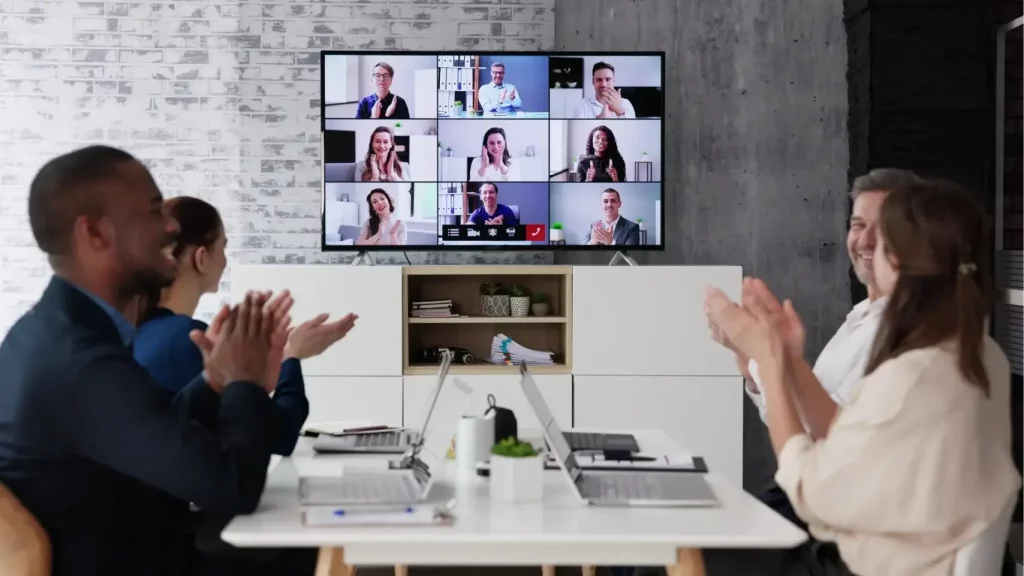
Peer-to-peer knowledge sharing, communities of practice, online forums, and collaborative projects.
Social learning works because it mirrors how people naturally learn. The LinkedIn Workplace Learning Report found that peer learning consistently ranks among the most valued development activities.
Works well for: Building organizational knowledge, cross-functional skill sharing, reinforcing formal training through discussion, and building team cohesion.
Breaks down when: There’s no structure or facilitation (it devolves into chat), when contribution isn’t recognized, or when the culture doesn’t support vulnerability (people only share wins, never struggles).
5. Coaching and mentoring
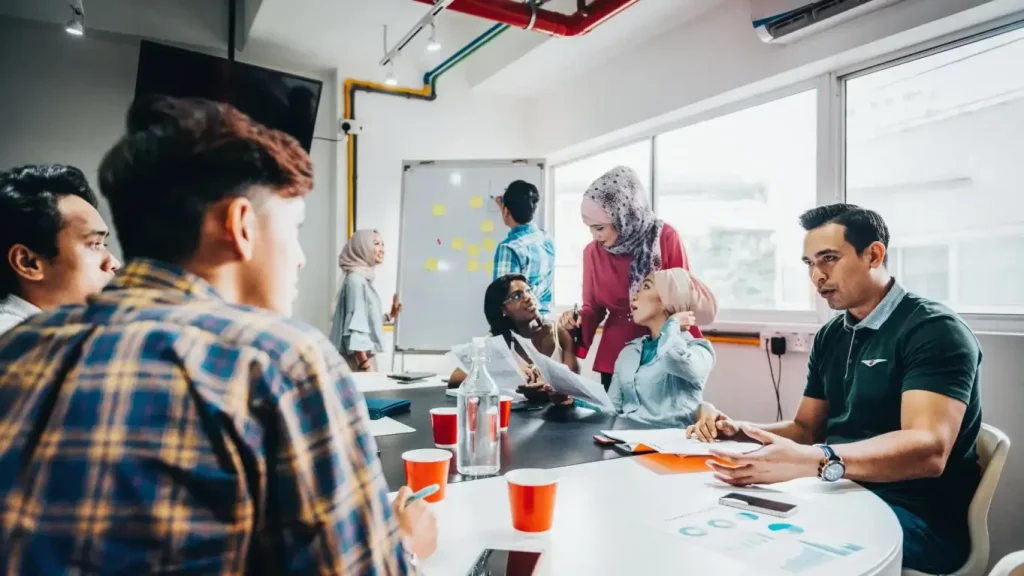
One-on-one relationships focused on personalized development, whether through human coaches, peer mentors, or AI coaching tools.
Works well for: Leadership development, behavior change, working through career transitions, and situations where the learner’s specific context makes generic advice useless. This is where tools like Risely’s AI coach Merlin add particular value, because coaching works best when it’s available in the moment a challenge arises, not weeks later in a scheduled session.
Breaks down when: Mentors don’t have training in how to mentor (good intentions aren’t enough), when the relationship feels forced, or when coaching is positioned as remediation rather than development.

How to build a learning environment that produces results
Knowing the types isn’t enough. Here’s what makes the difference between a learning environment that exists on paper and one that actually changes how people work.
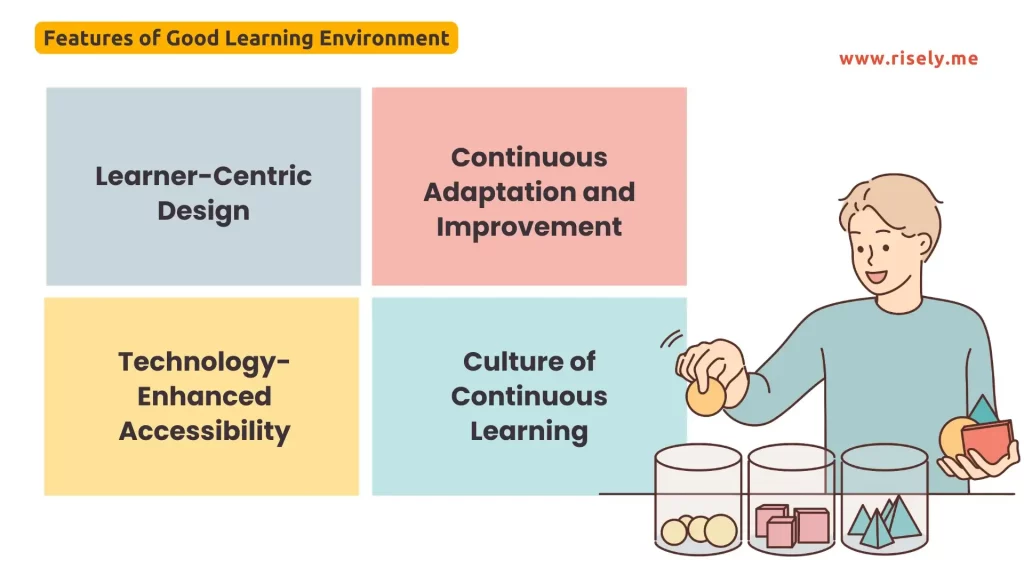
Put the learner at the center (not the content)
Most learning environments are designed around the content: “We have this material, how do we deliver it?” Flip the question: “What does this person need to learn, and what conditions will help them learn it?”
The difference is practical, not philosophical:
| Learning Environment Aspect | Content-Centered | Learner-Centered |
|---|---|---|
| Format | Fixed: everyone gets the same 2-hour session | Flexible: choose live, async, or blended |
| Pace | Instructor-driven schedule | Self-paced with checkpoints |
| Materials | Standardized slides for everyone | Role-specific content with multiple media options |
| Assessment | End-of-course quiz | Ongoing skill demonstration in real work |
Learner-centered design takes more upfront effort, but the return is dramatically higher engagement and application. When people feel like the learning was built for their situation, they take it seriously.
Build feedback loops into everything
The best learning environments aren’t static. They adapt based on what’s working and what isn’t.
This means gathering feedback before, during, and after programs. Not just satisfaction surveys (“Was the trainer engaging?”) but application feedback (“Did you use what you learned? What got in the way?”). It means watching completion data, tracking skill improvement over time, and being willing to scrap things that look good on paper but don’t produce results.
Use technology to expand access, not replace connection
Tech should make learning more accessible, not more isolated. The best uses of technology in learning environments include making content available across devices and time zones, providing personalized paths based on individual needs, creating safe spaces for practice (simulations, AI coaching), and enabling peer connection across locations.
The worst uses include replacing human interaction entirely, adding complexity without adding value, and choosing platforms based on features rather than learner experience.
Make learning part of the culture, not an event
A learning environment that only exists during scheduled training sessions isn’t really an environment. It’s a temporary setup. The organizations with the strongest learning environments are the ones where learning is woven into daily work.
This looks like managers who debrief projects by asking “what did we learn” instead of “what went wrong.” It looks like recognition for people who share knowledge, not just people who hoard it. It looks like leaders who are visibly learning themselves, not just mandating learning for others.
We spoke to Janis Cooper, who leads Leadership and Staff Development at Best Friends Animal Society, about what makes learning environments succeed. Her perspective on building environments where people feel safe enough to grow is worth watching:
When the learning environment is actively hostile
Sometimes the problem isn’t a neutral environment that needs improvement. It’s an environment that actively undermines learning. Hostile learning environments are more common than most L&D professionals want to admit, and they make everything else you’re building pointless.
How to spot a hostile learning environment
- People avoid asking questions in group settings
- Mistakes get public criticism rather than private coaching
- Certain individuals or groups are consistently excluded from development opportunities
- There’s a visible fear of looking incompetent
- Feedback flows down but never up
- Individual competition is rewarded over collaboration and knowledge sharing
What to do about it
Fixing a hostile learning environment isn’t an L&D problem alone. It’s a leadership and culture problem that requires partnership with HR, senior leaders, and people managers.
Start with the data. Anonymous surveys that specifically ask about psychological safety in learning contexts give you evidence rather than anecdotes. Share the findings with stakeholders who have the authority to act on them.
Then focus on the managers. They’re the ones who create (or destroy) psychological safety at the team level. Training managers on how to respond to mistakes, how to model vulnerability, and how to create space for questions will produce bigger results than any content improvement you could make.
The L&D strategy that works in a hostile environment is the one that addresses the environment first and the content second.
The environment is the strategy
You can have the best content, the most engaging facilitators, and the most sophisticated platform. If the environment doesn’t support learning, none of it matters. Conversely, a mediocre program in a strong learning environment will outperform a brilliant program in a hostile one.
That’s the real insight for L&D teams: your environment is your strategy. Every decision you make about physical spaces, virtual tools, social norms, and cultural expectations shapes whether learning sticks or slides off.
Build the environment first. The content will work harder when you do.
Related reading: