

Watch yourself the next time a conversation gets tense. Do you go quiet and change the subject? Smooth it over so nobody’s upset? Or push your call hard because you don’t have time for a debate? Whatever you do in those first ten seconds is your default conflict resolution style, and most managers have one without ever choosing it.
That’s the part the usual “here are the 5 styles” article skips. Knowing the five styles isn’t the skill. The skill is catching your own default, noticing when it quietly costs you, and switching to the style the moment actually needs. We’ll break down all five, but the real work is figuring out which one runs you on autopilot.
Why your default style is the thing to fix first
Your default is the style you reach for under stress, before you’ve thought about anything. It feels like personality, but it’s really a habit your nervous system built to make conflict less uncomfortable.
Two defaults are especially common. Plenty of managers retreat into Avoiding or Accommodating to dodge the discomfort of a hard conversation. Others snap into Competing the second they feel time pressure. Neither is wrong. The problem is that a default is one tool used on every job, and most conflicts don’t fit the one tool you happen to grab.
Here’s a quick way to spot yours. Think about the last three times work got tense and ask what you actually did, not what you wish you’d done:
- You went silent, deflected, or hoped it would pass on its own. That’s Avoiding.
- You gave in to keep the peace, even when you had a real point. That’s Accommodating.
- You pushed your decision through fast and shut down the debate. That’s Competing.
- You split the difference to wrap it up quickly. That’s Compromising.
- You slowed down, dug into what everyone actually needed, and built a solution together. That’s Collaborating.
If the same answer shows up across all three situations, you’ve found your default. Curious how it shows up at work specifically? Our conflict resolution assessment walks you through real scenarios and shows you the pattern you fall into under pressure.
The grid behind the 5 styles
The five styles come from a model Kenneth Thomas and Ralph Kilmann built in the 1970s, and it still holds up because it’s simple. They plotted every approach to conflict on two dimensions: assertiveness and cooperativeness.
Assertiveness is how hard you push to meet your own needs. Cooperativeness is how much effort you put into meeting the other person’s. Cross those two and you get five distinct positions.
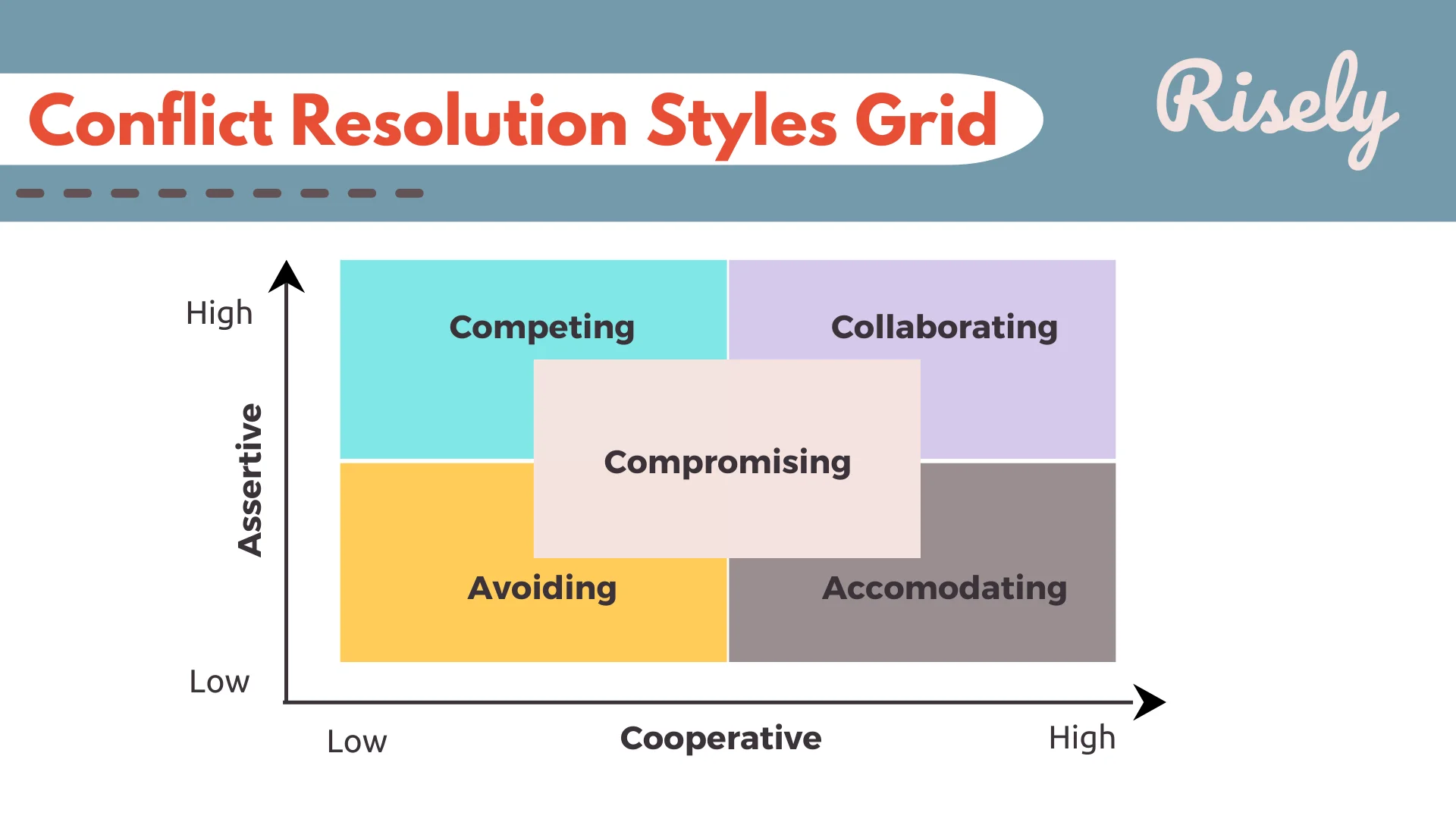
- Competing is high assertiveness, low cooperativeness.
- Accommodating is low assertiveness, high cooperativeness.
- Avoiding is low on both.
- Collaborating is high on both.
- Compromising sits in the middle of both.
None of these is the “right” one. Each is the right move in some situations and the wrong one in others, which is exactly why your default trips you up: it applies one fixed position to conflicts that need different ones. If you want a tighter view of how conflict resolution actually works at work, the styles are the toolkit and the situation tells you which to pull.
The 5 conflict resolution styles, and when each one backfires
Below, each style gets the part most articles leave out: what it’s genuinely good for, the signal that you’re overusing it, and the specific way it bites you when you reach for it on the wrong conflict.
Competing
The Competing style, sometimes called “forcing,” is high assertiveness and low cooperativeness. You prioritize your own goal and you’re willing to use your authority to get there. It’s the manager who makes the call and ends the debate.
Example: Two team members keep arguing over a project’s direction. The manager decides on the approach and tells both of them to follow it without further debate, confident it’s the right call for the project.
- Best for: genuine emergencies, decisions only you can own, situations where someone won’t negotiate in good faith.
- Overuse signal: people stop bringing you problems, and your meetings have gone quiet.
- Backfires when: the issue actually needed buy-in. You win the decision and lose the room, and the resentment shows up later as quiet non-compliance.

Accommodating
The Accommodating style, or “yielding,” is low assertiveness and high cooperativeness. You put the other person’s needs ahead of your own to keep the relationship intact and avoid a confrontation.
Example: A team member hits a personal crisis and asks for time off mid-project. The manager reassigns their tasks and grants it, deciding the person matters more than the short-term inconvenience.
- Best for: moments when you’re genuinely wrong, when the issue matters far more to them than to you, or when goodwill is worth more than the point.
- Overuse signal: you’re quietly frustrated a lot, and people have learned that asking you twice gets a yes.
- Backfires when: you give in on things that actually matter to you. It reads as a weak resolution, your needs go unmet, and others learn they can push you on the next one.
Avoiding
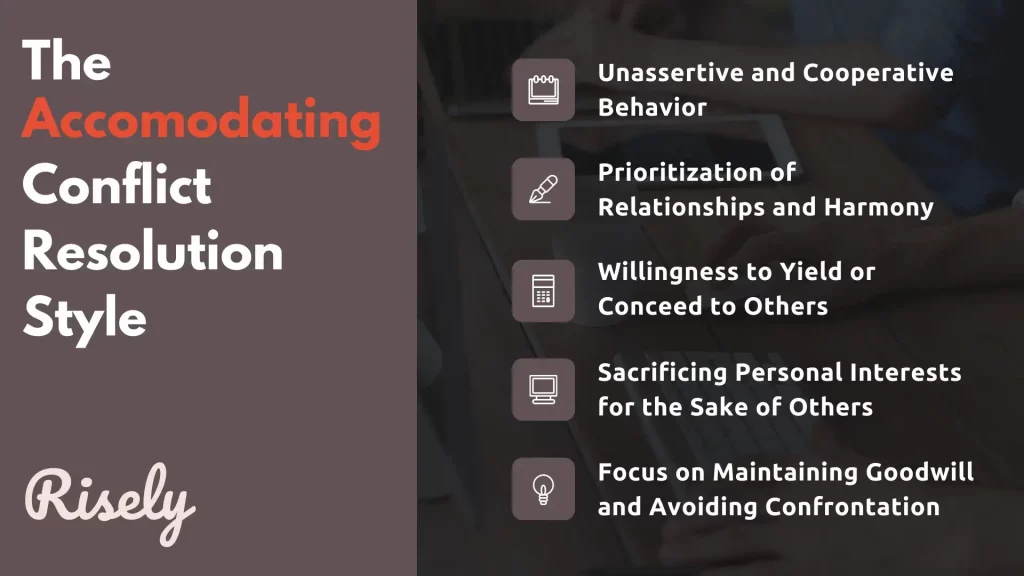
The Avoiding style, or “withdrawing,” is low on both assertiveness and cooperativeness. You sidestep or postpone the conflict and don’t surface your needs or theirs. Sometimes that’s wise. Often it’s just the default in a trench coat.
Example: A manager notices a minor friction between two team members and chooses not to step in, hoping it sorts itself out while they handle more pressing work.
- Best for: trivial issues genuinely not worth the energy, and moments when emotions are too hot to talk productively right now.
- Overuse signal: you’ve got a mental list of conversations you “need to have” that keeps getting longer.
- Backfires when: the issue matters and you dodge it anyway. The problem doesn’t disappear, it ferments, and your silence reads as a lack of leadership.
Collaborating
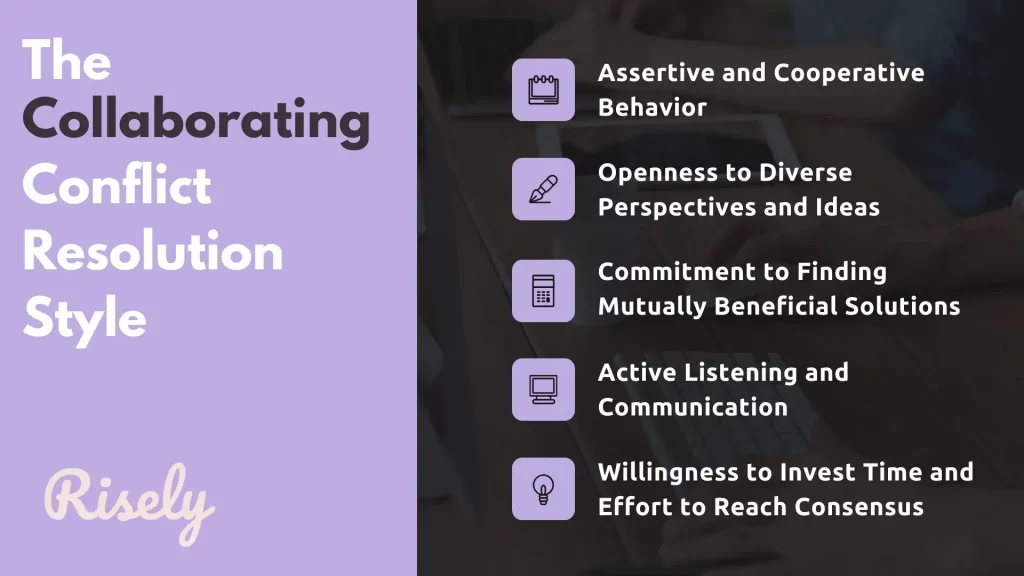
The Collaborating style, the “problem-solving” approach, is high on both assertiveness and cooperativeness. You work with the other party to find a solution that actually meets everyone’s needs rather than splitting the difference.
Example: A complex problem hits the team, and the manager pulls everyone involved into a working session, drawing out perspectives and expertise to build a solution together.
- Best for: high-stakes issues where the ongoing relationship matters and there’s room to find something better than a trade-off.
- Overuse signal: you’re convening a meeting and a deep discussion over things that needed a two-minute decision.
- Backfires when: you collaborate on the trivial. It’s slow and expensive, and if one party won’t engage honestly, you’ve spent an hour to arrive where Competing would’ve landed in five minutes.
Compromising
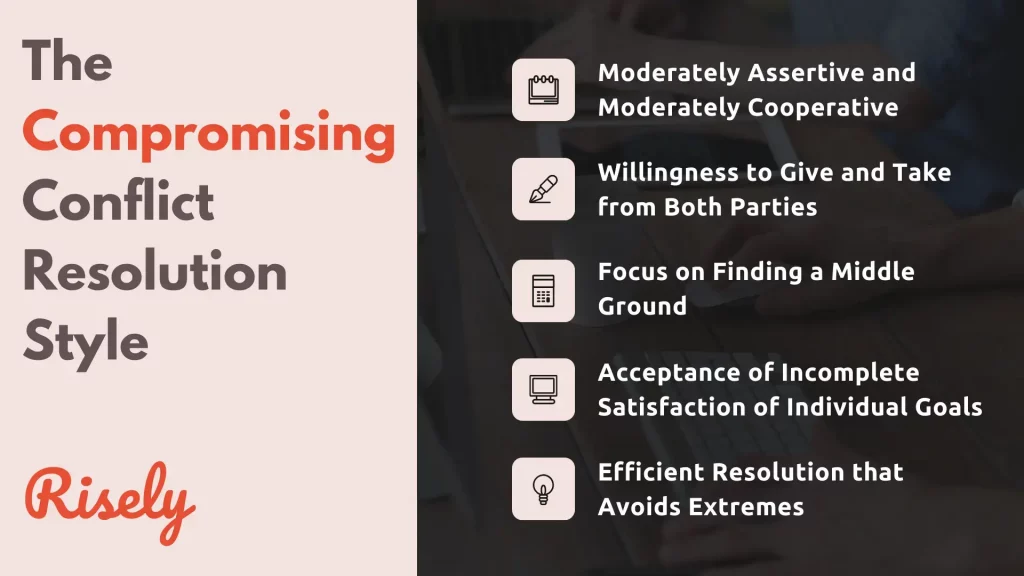
The Compromising style is moderate on both dimensions. Everyone makes concessions and meets in the middle, even when the middle isn’t anyone’s favorite outcome. It’s the fast, fair-enough option.
Example: Two team members disagree on how to allocate resources for a project. The manager hears both out and proposes a middle-ground split that asks each of them to give a little.
- Best for: roughly equal parties at an impasse, time pressure, and situations where “good enough and done” beats “perfect and late.”
- Overuse signal: you reach for splitting the difference before you’ve understood what either side actually needs.
- Backfires when: a real solution was available and you settled for the average instead. Both sides walk away half-satisfied, and the underlying issue resurfaces because nobody’s core need got met.
If you want more tactical moves on top of the styles, here are 6 ways to manage conflict at work as a manager that pair well with picking the right one.
How to pick the right style in the moment
You don’t need to memorize a matrix. In the heat of a conflict, two quick questions get you most of the way there: how high are the stakes, and does the ongoing relationship matter?
Run those two against each other and the style mostly chooses itself:
| The situation | Reach for | Why |
|---|---|---|
| High stakes + relationship matters | Collaborating | The time pays off; you both live with the outcome for a while. |
| High stakes + you must own the call | Competing | Someone has to decide, and that’s you. |
| Time pressure + roughly equal footing | Compromising | Fair-enough and done beats perfect and late. |
| Trivial issue, or emotions too hot right now | Avoiding (on purpose) | Not every hill is worth it; some need cooling first. |
| You’re wrong, or it matters far more to them | Accommodating | Spend the goodwill where it counts. |
The phrase to hold onto is Avoiding on purpose. There’s a world of difference between sidestepping a tough talk because it scares you and deciding, with clear eyes, that this particular issue isn’t worth the energy. Same with every style. The move is fine. Doing it on autopilot is the problem.
A few habits that make the choice easier:
- Name the stakes out loud before you react. A quick “is this actually a big deal?” buys you a second to choose instead of defaulting.
- Watch your biases. Your own blind spots shape how big a conflict feels, so check whether you’re reacting to the issue or to the person.
- Expect to switch mid-conflict. A single disagreement can start hot, so you might Avoid for an hour to let people cool, then Collaborate once heads are clear.
- Stay open to feedback. If your read on the situation is off, adjusting your approach early beats defending the wrong one. Good feedback habits cut both ways here.
For the structured version, our free Conflict Management Toolkit gives you a framework for reading the conflict in front of you and building a resolution that holds. And if you’re hiring for this, here are 6 conflict management interview questions that reveal whether a candidate can read a situation or just runs one default.
The hard part isn’t knowing the styles, it’s noticing your default in real time
You can read all five styles and still snap into your default the moment your heart rate climbs. That’s the gap. Knowing what you should do and catching yourself before you do the thing you always do are two different skills, and the second one is the one that changes outcomes.
This is where coaching earns its keep. Merlin, Risely’s AI coach, works on exactly this: it helps you spot the pattern you fall into under pressure, replays a real conflict you’re sitting in, and rehearses the harder style before you walk into the room. It lives natively inside Slack and Microsoft Teams, so the nudge to notice your default reaches you right where the tense thread is happening, not in a course you’ll get to later.
The point isn’t to become a perfect Collaborator. It’s to stop being run by one style. The managers who handle conflict well aren’t the ones with the best style; they’re the ones who catch themselves about to default and choose something else. That awareness is a skill you can build with Merlin before the next tense conversation.
Start by catching yourself once
Pick the next tense conversation on your calendar. Before you walk in, name your likely default and decide on purpose whether it fits the stakes and the relationship. If it doesn’t, choose the style that does and go in with it. One deliberate switch teaches you more than any framework.
Want a coach in the room with you for it? Try Merlin free and work through a real conflict before it happens, so you catch your default in time to change it.